In fixed prosthodontics, the impression is not just a record. It is the blueprint for the crown, bridge, or partial-coverage restoration that has to seat on real tooth structure with almost no tolerance for drift. Conventional impressions for fixed prostheses are expected to reproduce detail in the 20 to 70 micron range, so even a small amount of tray flex, material rebound, or adhesive failure can show up later as an open margin, a high spot, or a remake.
That is why the real issue in custom tray vs stock tray is not prestige or habit. It is risk control. The question is whether the tray system helps you control the variables that actually move the outcome: dental impression tray accuracy, impression material thickness, tray rigidity, adhesive reliability, and cross-arch stability. In some cases, a rigid stock tray works extremely well. In other cases, it leaves too many variables uncontrolled, and the difference shows up at delivery.
This question matters even more now because conventional impressions are no longer the automatic default. Many short-span, dry-field cases scan beautifully. But when the field is wet, margins are deep, tissue is unstable, or the case becomes long-span or full-arch, analog PVS often becomes the safer choice again. A practical scan-versus-PVS guide makes that distinction clearly: dual-arch can work for a single posterior case when it is truly accurate, but custom trays are favored for long spans and full-arch cases, and PVS is preferred when biology or cross-arch stability makes digital capture less predictable.
So this is not a simple “custom good, stock bad” article. It is a best-practices guide to when custom tray vs stock tray truly changes the outcome, when dental impression tray accuracy is likely to change the fit of the restoration, and how PVS custom tray use, full arch impression tray selection, tray adhesive protocol, and impression distortion dentistry all connect in real fixed cases.
Why dental impression tray accuracy matters in fixed cases
When a patient needs a crown or bridge, the lab is building to what the impression says is true. If that record is wrong, the lab can still produce a technically beautiful restoration that is clinically wrong. That is why dental impression tray accuracy is not a minor detail. It is the difference between a restoration that seats with a light adjustment and one that burns chair time.
In practical terms, poor dental impression tray accuracy tends to show up in familiar ways:
- open or rolled margins
- contacts that are too tight or too open
- high occlusion
- bridges that bind on one retainer
- crowns that appear fine on the die but do not seat intraorally
Those outcomes are not always caused by the tray alone, but tray selection influences several of the biggest error sources: flexure, uneven bulk, poor adhesive retention, and distortion during removal. A practical analog-impression guide specifically warns against rocking the tray, removing PVS early, and ignoring pulls, drags, tray show-through, or voids at the finish line.
This is also why impression distortion dentistry should be treated as a systems problem, not a material-brand problem. The distortion may start with a flexible tray, but it can be amplified by wash bulk, poor tray fit, rushed adhesive drying, or removal under stress. When all of those factors line up against you, the restoration usually does not “almost fit.” It misses in ways that cost time.
What custom tray vs stock tray really means
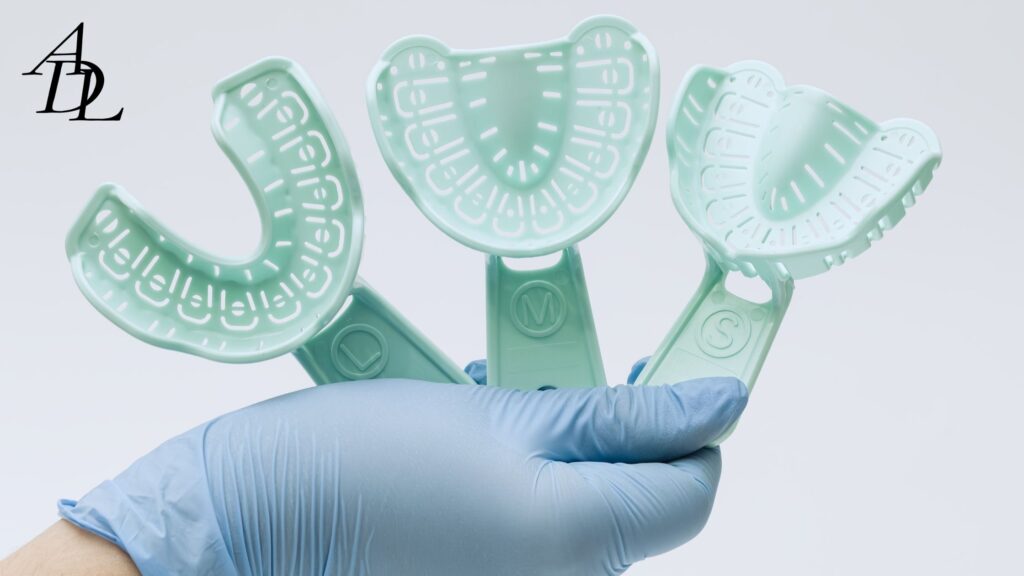
A stock tray is prefabricated and comes in standard sizes. A custom tray is fabricated for the individual case, usually on a cast, to control spacing and extension more precisely. That simple difference is the reason the custom tray vs stock tray debate has lasted so long: one option prioritizes speed and convenience, while the other prioritizes control.
The biggest technical advantage of a custom tray is not that it is “special.” It is that it can create a more uniform layer of impression material. Multiple sources in the impression literature state that elastomeric impression materials are most stable when they have an even thickness of about 2 to 4 mm, and one tray-space study found that 2 to 4 mm spacing produced more accurate stone casts than 6 mm spacing. Another study found that a custom tray with 2.0 to 2.5 mm spacing produced the least variation.
That point is easy to underestimate. Impression material thickness is not just a consumption issue. It is a distortion issue. The more uneven the material bulk, the less predictable polymerization shrinkage and elastic recovery become. A PVS custom tray is valuable because it gives the clinician a better chance of holding that thickness inside a narrower and more repeatable range.
Stock trays, on the other hand, are not inherently inaccurate. A rigid stock tray can perform very well in the right case. The problem is that stock trays usually create more variation in space, fit, and support from one patient to the next. In other words, custom tray vs stock tray is really a question of how many uncontrolled variables you are willing to accept in a given case.
What the literature actually says about custom tray vs stock tray
The research does not support a simplistic all-or-nothing answer. A classic study by Millstein and colleagues found that casts made from custom tray impressions were more accurate and more consistent than those made from stock trays. That finding is one reason custom trays have retained such a strong reputation in prosthodontics.
At the same time, a later study by Rueda and colleagues found only a small statistical difference between casts made from stock and custom trays, and concluded that the difference might not always be clinically significant. Importantly, though, that same study still found the least variation with a custom tray spacing of 2.0 to 2.5 mm. That is an important nuance: the difference between tray types is not always dramatic, but thickness control still trends in the custom tray’s favor.
More recent work adds another layer. A 2024 study reported high impression accuracy with both polyether and vinyl polysiloxane when used with different 3D-printed and customized trays for smaller fixed prostheses, while still concluding that manually fabricated trays remained the best option when the highest precision was required. That fits the real-world view nicely: modern tray systems can work well, but the closer the case gets to “mission critical,” the more attractive the custom option becomes.
So the best reading of custom tray vs stock tray is this: custom trays generally improve control and consistency, but rigid stock trays can still be clinically sound in smaller, simpler fixed cases. The outcome changes when the case becomes less forgiving.
When custom tray vs stock tray actually changes the outcome
A useful chairside question is not “Which tray do I prefer?” It is “Will any small distortion in this case be amplified at delivery?”
Tray choice starts to matter more when one or more of these are true:
- The case is long-span, splinted, or cross-arch.
- The margins are subgingival or moisture control is uncertain.
- The stock tray would create uneven impression material thickness.
- The tray material is flexible.
- Occlusion and arch relationships matter enough that a quadrant record is not enough.
- The case has already had one failed or questionable impression.
Single posterior crowns: where stock trays can still win
For a single posterior crown with visible equigingival margins, good isolation, and a stable bite, the custom tray vs stock tray decision often does not change the outcome much. In fact, a pilot study found that dual-arch impressions were comparable in accuracy to impressions made with custom trays, although accuracy decreased when the tray was stressed or distorted. A practical clinical guide also recommends dual-arch for single posterior cases when it is truly accurate.
That does not mean “any stock tray is fine.” It means a rigid tray in a forgiving case can be very efficient. The key conditions are passive fit, stable occlusion, visible margins, and no tray flex. If any of those disappear, the safety margin disappears too.
Long-span bridges: where custom trays usually earn their keep
The longer the span, the more dental impression tray accuracy becomes a cross-arch problem instead of just a finish-line problem. A practical PVS guide identifies long-span bridges as situations where PVS is favored because cross-arch verification and soft-tissue control matter more. A modern study also found that although overall accuracy was good across tray/material combinations, the greatest deviations appeared over distances exceeding one quadrant of the dental arch.
That is exactly where a custom tray often changes the outcome. Once a case spans multiple units, even a modest amount of flex or uneven wash bulk can be magnified across the arch. In those cases, a full arch impression tray or a custom PVS custom tray is usually a better risk-management move than a convenient sectional tray.
Flexible plastic trays: where problems start fast
One of the clearest messages in the literature is that tray rigidity matters. In a crown-and-bridge study, metal and rigid plastic stock trays produced the least discrepancy, around 50 microns, while flexible plastic trays produced far greater discrepancies, approximately 180 to 210 microns depending on the putty used. That is not a subtle difference in fixed work.
The important lesson is that dental impression tray accuracy is not only about custom versus stock. It is also about rigid versus flexible. A 1989 study went even further and warned that some non-rigid impression trays, including disposable plastic trays and even custom-made acrylic resin trays, may produce unreliable impressions. So a poorly designed custom tray is not automatically better than a rigid stock tray.
When a full arch impression tray is the safer choice
A full arch impression tray becomes more important when the restoration is part of a larger occlusal picture. A practical fixed-impression guide recommends custom trays for long spans and full-arch cases, and highlights full-arch PVS as the safer option when there are multiple pontics, combination cases, or situations where stitch-error risk or tissue detail makes digital speed less important than analog stability.
In simple language, a full arch impression tray is safer when the lab needs the whole map, not just the prepared tooth. If the opposing contacts, lateral pathways, or contralateral stabilization matter to how the restoration will function, the broader record often beats the faster one. That is one of the most important points in custom tray vs stock tray decision-making for fixed cases.
Why a PVS custom tray still matters in modern fixed prosthodontics
PVS, or polyvinyl siloxane, remains one of the most important conventional impression materials for fixed dentistry because of its accuracy, tear strength, and elastic recovery. In modern practice, a PVS custom tray earns its place when the case cannot be made predictable by speed alone. That includes deep margins, long spans, full-arch fixed work, and wet or hemorrhagic fields that challenge scanners and increase the value of physical tissue displacement.
A practical analog guide recommends heavy plus light body for fixed cases, putty plus wash for difficult fields, and custom tray selection for long spans and full-arch work. That is not just a material preference. It is a strategy for controlling wash thickness, limiting flex, and improving the odds that the detail recorded at the chair survives tray removal and reaches the die intact.
A PVS custom tray is especially useful in these fixed situations:
- multiple prepared teeth across a quadrant or arch
- bridges where cross-unit continuity matters
- subgingival margins that need dual-viscosity control
- occlusion-heavy rehabilitations where a full arch impression tray is safer
- any case where a stock tray would leave visibly uneven wash space
Those are the situations where custom tray vs stock tray is no longer theoretical. It becomes a direct fit-and-remake issue.
Impression material thickness: the silent variable behind many failures
If there is one variable that explains why custom trays often outperform stock trays, it is impression material thickness. Elastomeric materials are most stable when they are kept in an even layer rather than in random pockets of thick and thin material. Several sources place that ideal zone at about 2 to 4 mm, and one controlled tray-space study found that 2 to 4 mm spacing produced more accurate casts than 6 mm spacing.
That finding matters because stock trays often create exactly the kind of inconsistent bulk clinicians do not see clearly once the tray is loaded. One wall may be starved. Another may be overbuilt. The prep area may be acceptable while the rest of the tray is carrying more bulk than ideal. A custom tray reduces that randomness.
Signs that impression material thickness is working against you include:
- obvious tray show-through near one area and excessive bulk elsewhere
- a tray that fits loosely before loading
- heavy putty displacing the wash unpredictably
- repeated drags or pulls on the same case
- a bridge case that looks good on one retainer and not the other
A practical PVS checklist specifically flags tray show-through, drags, pulls, and voids as signs to reject the impression. Those are not cosmetic imperfections. They are warning signs that the thickness and seating dynamics were not controlled well enough.
Tray adhesive protocol: the step clinicians rush too often
Even the right tray can fail if the material loses adhesion to it during polymerization or removal. That is why tray adhesive protocol is not a side step. It is part of the impression system. A general impression-making review includes tray adhesive as a basic preparatory step before elastomeric impression making, and bond-strength work has long argued that the best-performing impression material–adhesive–tray combination should be chosen for optimal clinical performance.
The part clinicians most often rush is drying time. In one study on VPS adhesives, at least 10 minutes of drying was needed for one adhesive/material combination and 15 minutes for another to reach appropriate tensile bond strength. That is a useful reminder that “paint and load immediately” is not a reliable tray adhesive protocol for high-accuracy fixed cases.
The safest takeaways for tray adhesive protocol are simple:
- Use a compatible adhesive system for the material and tray you are using.
- Apply it before you are under time pressure.
- Let it dry fully rather than guessing.
- Do not assume a fast clinical schedule cancels the chemistry.
Those steps matter because impression distortion dentistry can start at the tray wall, not just at the finish line.
Impression distortion dentistry: where the errors really come from
Most clinicians recognize obvious bubbles. Fewer think immediately about tray flex, rebound, or adhesive separation. But those are classic causes of impression distortion dentistry, especially in fixed work where the margins are unforgiving. A practical analog guide warns against rocking the tray, removing it early, and accepting pulls, drags, or tray show-through. The fixed-prosthodontic literature adds another common culprit: flexible trays that distort on insertion or removal.
Common causes of impression distortion dentistry in fixed cases include:
- flexible plastic stock trays used with high-volume putty/wash techniques
- uneven impression material thickness
- inadequate tray adhesive drying
- tray movement during seating
- removal before full set and elastic rebound
- using a quadrant tray when a full arch impression tray was needed
None of those errors are exotic. That is exactly why they matter so much. Most remakes come from ordinary variables that were not controlled well enough.
How to choose chairside without overthinking it
A practical decision process for custom tray vs stock tray looks like this:
- Ask whether the case is truly short-span and forgiving.
If it is a single posterior crown with visible margins, controlled saliva, and stable occlusion, a rigid stock tray or carefully selected dual-arch approach may be entirely reasonable. - Ask whether the stock tray can provide even space.
If you cannot get predictable impression material thickness, the tray is already the wrong tray. - Ask whether rigidity is assured.
If the tray flexes, accuracy falls fast. This is especially important with putty/wash techniques and multi-unit fixed work. - Ask whether the case needs a full arch impression tray.
If occlusion, multiple retainers, or cross-arch relationships matter, the broader record is often safer. - Ask whether your tray adhesive protocol is good enough for the plan.
If adhesive is being rushed, the rest of the technique is already less predictable.
That framework keeps the custom tray vs stock tray decision grounded in outcome rather than habit. It also explains why two experienced clinicians can both be “right” while choosing different trays for different cases.
Practical examples
Example 1: Single lower molar crown with clear margins
A second molar has a supragingival chamfer, easy moisture control, and a stable bite. This is the kind of case where dental impression tray accuracy may not meaningfully improve by fabricating a custom tray. A rigid stock tray or a well-managed dual-arch impression can perform well, especially when the tray is not stressed and the adhesive is handled correctly.
Example 2: Three-unit bridge with deep posterior margins
Now the case is less forgiving. The margins are partly subgingival, the tissue is not perfectly dry, and the restoration has multiple retainers that must seat together. Here, a PVS custom tray and often a full arch impression tray are more defensible choices because they improve control of wash thickness and cross-unit continuity. This is where custom tray vs stock tray often changes the clinical outcome.
Example 3: Anterior four-unit bridge with esthetic and occlusal risk
An anterior bridge with multiple finish lines and esthetic demands is not just a marginal-detail case. It is an arch-relationship case. Even if a quadrant record looks fast, the restoration may depend on fuller occlusal and arch information. A full arch impression tray or a hybrid scan-plus-PVS verification strategy is often the safer answer.
Example 4: Repeat impression after an unexplained seating problem
A crown was made from a flexible stock tray impression and repeatedly binds at seat. The remake is the moment to stop blaming the lab and reevaluate the impression system. Moving to a rigid stock tray or custom tray, controlling impression material thickness, and honoring the tray adhesive protocol often changes the result more than changing materials alone.
Common mistakes in custom tray vs stock tray decision-making
The first mistake is assuming that the debate is about custom versus stock in the abstract. It is not. It is about rigidity, spacing, adhesive reliability, and case complexity. That is why some stock trays work beautifully and some custom trays still fail.
The second mistake is ignoring impression material thickness. Clinicians often focus on the brand of PVS while overlooking the fact that the tray is creating a poor geometry for the material to work in. Yet the literature repeatedly points back to the same answer: stable elastomeric impressions depend on even bulk, usually around 2 to 4 mm.
The third mistake is treating tray adhesive protocol like a convenience step. Adhesive that has not dried properly is a classic source of distortion on removal. The studies on adhesive drying time make that point very clearly.
The fourth mistake is forcing a sectional or dual-arch approach when the case actually needs a full arch impression tray. Single units can be forgiving. Cross-arch and multi-unit cases usually are not.
The fifth mistake is assuming that a flexible plastic tray is “close enough” for crown and bridge impressions because the prep is small. Crown-and-bridge data show that flexible trays can introduce discrepancies large enough to matter.
Conclusion
The real lesson in custom tray vs stock tray is that the answer is rarely ideological. It is conditional. When the case is short-span, dry, visible, and mechanically forgiving, a rigid stock tray may deliver excellent dental impression tray accuracy. When the case becomes long-span, full-arch, subgingival, tissue-driven, or simply less tolerant of error, a custom tray usually earns its place by reducing uncontrolled variables—especially impression material thickness, tray flex, and adhesive risk.
Associated Dental Lab is a dentists’ trusted Full-Service Dental Lab in Los Angeles, crafting smiles since 1962. The lab supports both analog and digital workflows, direct technician communication, CAD/CAM production, premium materials, and consistent case support across crown and bridge, implant, removable, and guards-and-trays work. If you want a Dentists trusted Full-Service Dental Lab that understands why accurate records matter from the first impression to final seat, contact Associated Dental Lab and make them your go-to lab partner.
FAQ
Is custom tray vs stock tray really a big deal for a single crown?
Not always. In a simple single posterior crown with visible margins, good isolation, and stable occlusion, custom tray vs stock tray may not create a large clinical difference, and dual-arch impressions have been reported as comparable to custom trays in some conditions. But that assumes the tray is rigid and not stressed. Once tray flex or unstable occlusion enters the picture, dental impression tray accuracy falls off quickly.
When is a PVS custom tray better than a stock tray?
A PVS custom tray is usually the better option when the case involves long spans, full-arch records, deep or wet margins, or any situation where controlling impression material thickness is critical. That is also the zone where many practical guides recommend custom trays over stock trays for analog fixed impressions.
What impression material thickness gives the best dental impression tray accuracy?
The literature repeatedly points to a fairly even thickness of about 2 to 4 mm for elastomeric materials, and one study found that trays spaced 2 to 4 mm produced more accurate casts than 6 mm spaced trays. Another found the least variation with a custom tray spacing of 2.0 to 2.5 mm. That is why impression material thickness is one of the core advantages of a well-made custom tray.
How important is tray adhesive protocol in avoiding impression distortion dentistry?
Very important. Tray adhesive protocol is part of the impression system, not a minor accessory step. Research on VPS tray adhesives found that some adhesive/material combinations needed at least 10 to 15 minutes of drying time to achieve appropriate tensile bond strength. If the adhesive is rushed, impression distortion dentistry can begin before the tray ever leaves the mouth.
When should I switch from a sectional tray to a full arch impression tray?
A full arch impression tray becomes the better choice when occlusion, multiple retainers, cross-arch relationships, or long spans matter more than speed. Practical fixed-impression guidance specifically favors custom trays for long spans and full-arch cases, because they provide better control when arch-wide stability matters.
Can a stock tray still deliver good dental impression tray accuracy?
Yes, but conditions matter. Rigid stock trays can be very accurate in selected fixed cases, and some studies suggest the difference between stock and custom trays may not always be clinically significant. Still, flexible plastic trays have repeatedly shown worse performance than rigid trays, especially in crown and bridge work.
What are the most common causes of impression distortion dentistry in fixed cases?
The common culprits are flexible trays, uneven impression material thickness, rushed tray adhesive protocol, rocking during seating, early removal, and ignoring visible defects such as tray show-through, drags, pulls, or voids. These are the routine errors that make impression distortion dentistry look like a lab problem later.