Every delayed restoration has a moment when the delay was still easy to prevent. Most of the time, that moment is the handoff. When dental lab case communication is incomplete, the lab has to stop, ask follow-up questions, wait for files, clarify shade, confirm materials, or push the case back in the queue. When the dental lab prescription is complete, the case can move from intake to design to fabrication with fewer interruptions. Associated Dental Lab’s own Rx guidance makes this point clearly: vague, incomplete, or conflicting instructions create the emails, calls, shipping delays, and reappointments that can stretch a straightforward case into a long week.
This matters even more in modern dentistry because practices now juggle scans, conventional impressions, photos, bite records, implant libraries, and patient scheduling all at once. Associated Dental Lab positions itself around direct technician communication, digital integration, analog support, and streamlined submission because those systems reduce the friction between the operatory and the lab bench. In other words, better dental lab case communication is not just a courtesy. It is a production strategy.
For general readers, a dental lab prescription is the written instruction set a dentist sends to the dental laboratory. It tells the lab what to make, how to make it, what records support the case, when it is needed, and who can approve design decisions. Think of it as the blueprint for the restoration. If the blueprint is thin, the case slows down. If the blueprint is clear, the handoff becomes predictable. That is why the best offices treat dental lab case communication as a repeatable workflow, not a last-minute email.
In this guide, you will learn how to build a stronger dental lab prescription, use a practical lab Rx checklist, send useful case photos for lab review, choose the right file formats for lab submission, handle the implant/crown bridge handoff without guesswork, and improve turnaround time scheduling so the patient schedule and the lab schedule stay aligned. The examples and service references below are drawn from Associated Dental Lab’s published guidance, FAQ, and service pages.
Why dental lab case communication breaks down
The hidden cost of one missing detail
The biggest myth in case management is that delays happen because labs are simply “busy.” Sometimes that is true, but just as often the real problem is that the case is not truly ready. Associated Dental Lab’s Rx article highlights the common culprits: conflicting instructions between the Rx and the photos, missing bite or opposing records, shade notes without a stump shade or reference image, implant cases without brand or platform details, and removable cases with no clasp or undercut guidance. Each of those gaps creates a pause. Each pause creates a new message. Each message eats time.
Typical handoff failures look like this:
- The prescription says zirconia, but does not say which zirconia or what to do if clearance is limited.
- The photos suggest one shade, while the written instructions suggest another.
- The office sends an upper scan but no opposing scan or bite record.
- The implant case includes a scan but not the implant system, platform, or scan-body information.
- The removable case says “add clasps” without identifying clasp type, location, undercut depth, or path of insertion.
That list mirrors the exact failure patterns Associated Dental Lab calls out when explaining why cases stall.
Why a dental lab prescription is more than a form
A strong dental lab prescription is not just paperwork to satisfy a requirement. It is the document that tells the lab what success looks like. When the dental lab prescription is precise, the technician can follow the plan with confidence. When it is vague, the technician is forced to guess, escalate, or wait. None of those outcomes helps the patient.
Associated Dental Lab even recommends thinking of the Rx as a work authorization rather than a sticky note. That mindset is useful because it changes how a team fills it out. Instead of asking, “Did we send something?” the better question becomes, “Did we send enough for the lab to build exactly what we want without stopping?” That is the standard that improves dental lab case communication across crown and bridge, implant, and removable workflows.
What a complete dental lab prescription should include
The six-step framework
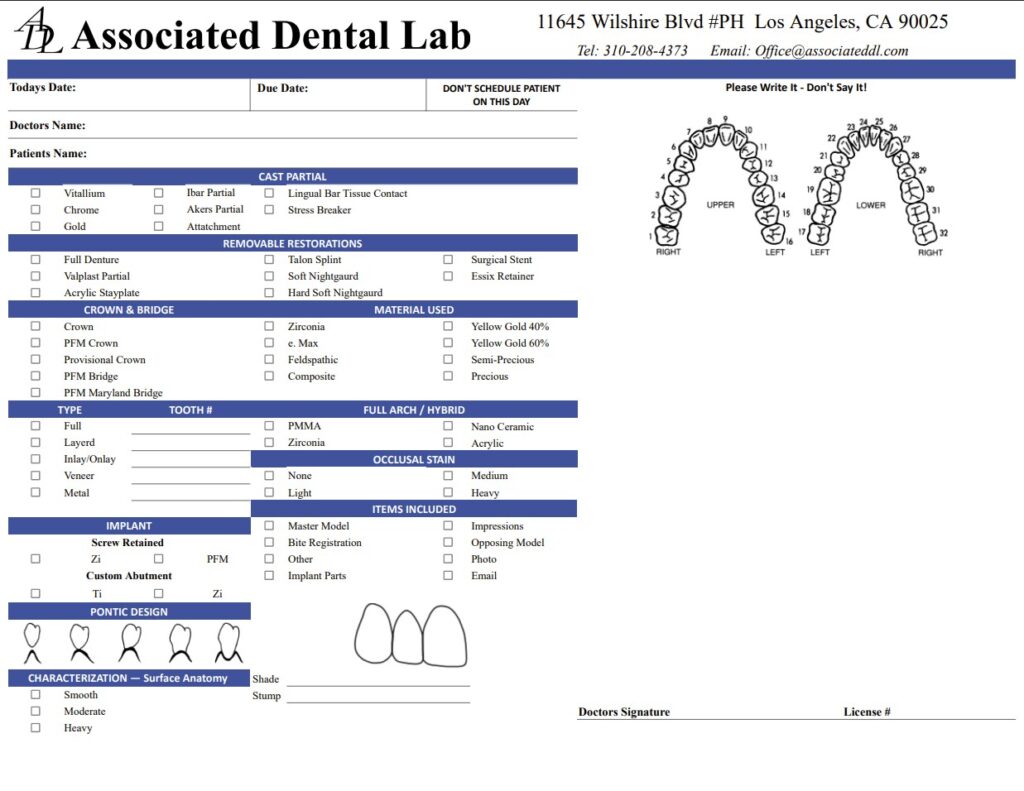
Associated Dental Lab’s step-by-step guidance can be turned into a simple six-part framework for every dental lab prescription:
- Decide the restoration and the fallback plan.
Choose the intended material and specify what the lab should do if space, shade, or strength requirements change. - Build the shade package.
Include the base shade, stump shade when relevant, and esthetic notes that explain translucency, texture, or characterization. - Attach the right records.
Fixed cases need the preparation, opposing, and bite. Implant cases need correct implant metadata and soft-tissue information. Removables need design guidance such as clasp plans and undercut maps. - State occlusion goals in one line.
Do not make the lab guess how tight or light the contacts should be. - Add logistics.
Include the due date, patient appointment date, and whether the case is standard or rush. - Double-check consistency.
Make sure the written instructions, scans, and photos tell the same story.
That sequence is a strong starting point for any dental lab prescription because it follows the same logic ADL publishes for faster case movement.
The core fields every handoff should contain
If you want a one-screen summary of essential dental lab case communication, use these fields every time:
- Case type
- Material and backup option
- Shade, stump shade, and esthetic notes
- Records attached
- Occlusion and contact goals
- Implant metadata, if relevant
- Removable design specifics, if relevant
- Due date and patient seat date
- Approver contact
- Special notes such as “copy provisional contours”
Those items are not arbitrary. They closely match Associated Dental Lab’s published “must-have fields” and printable checklist, including case type, material plan, shade package, records, implant details, removable specifics, due date, approver, and consistency check.
Consistency matters as much as completeness
A case can include a lot of information and still be confusing. That happens when the data contradict each other. For example, the written prescription might say A2, the photo tab suggests A1, and the provisional appears much brighter. Or the case might include a scan and an opposing, but no bite. Or the restoration may be listed as screw-retained while the notes imply cement-retained. In dental lab case communication, contradictions are often worse than omissions because they force the lab to stop and verify which version is correct. Associated Dental Lab explicitly recommends a consistency check between Rx, photos, and scans before submission.
The lab Rx checklist every team should standardize
A lab Rx checklist is what turns good intentions into a repeatable system. Without one, every assistant, front desk coordinator, and doctor fills cases out slightly differently. With one, the office develops a reliable rhythm.
A practical lab Rx checklist can look like this:
- Confirm the case type before anything else.
- Confirm the material and fallback instruction.
- Confirm the shade package and whether case photos for lab review are attached.
- Confirm the required records for that case category.
- Confirm the due date and actual patient appointment date.
- Confirm whether the case is standard or rush.
- Confirm who can approve a design or answer same-day questions.
- Confirm that the photos, files, and written notes agree with each other.
- Confirm that the outgoing email thread or portal entry uses a clear subject line and case identifier.
This kind of lab Rx checklist reflects ADL’s own advice to use a role-based checklist, assign an approver, and confirm records, logistics, and consistency before the case leaves the office.
The real value of a lab Rx checklist is not administrative neatness. It is speed. A checklist prevents the office from having to reconstruct missing information after the fact. It also lowers the risk that a case sits untouched because the lab is waiting for something the team assumed had already been sent. That is why strong dental lab case communication often begins with the front desk, not just the doctor.
Case photos for lab: the visual records that prevent costly guesswork
What to photograph
Case photos for lab use are not an optional extra for “cosmetic” cases only. They are one of the fastest ways to reduce interpretation errors. Associated Dental Lab recommends a shade package that includes retracted photos with the shade tab at the incisal edge, stump shade when needed, and any esthetic characterization notes. In implant esthetic work, ADL also highlights the value of retracted shade and soft-tissue photos and, when appropriate, smile dynamics. For removable cases, photos of high frena and visible tissue landmarks can also matter.
A strong set of case photos for lab communication usually includes:
- A retracted frontal photo with the shade tab next to the tooth
- A second retracted photo from a slightly different angle
- A close view for stump shade when using translucent ceramics
- A photo of the provisional if the lab is meant to copy contours or length
- A soft-tissue photo for implant emergence or esthetic zone work
- A smile photo when facial context matters
That structure follows the type of photographic support ADL repeatedly asks offices to send with shade and esthetic instructions.
Why case photos for lab review save real time
Written descriptions are useful, but they rarely carry the full esthetic story. “Match #8” sounds clear until the lab sees that #8 has internal warmth at the cervical, a lighter incisal edge, and a texture pattern that would never be captured by a single shade notation. Case photos for lab review solve that problem fast. They give the technician a shared reference point and reduce the chance of an extra shade call or remake. Associated Dental Lab’s FAQ specifically notes that detailed shade matching and characterization work best when photos and specific notes are included.
The photo mistakes that create delay
Bad photos can be almost as unhelpful as no photos. Common errors include using filtered phone images, holding the shade tab far in front of the tooth, sending a casual smile shot without retraction, or changing the shade choice mid-case without updating the prescription. ADL’s Rx guidance warns against low-value images and emphasizes proper shade-photo technique. If the technician cannot trust the visual reference, the case falls back onto clarification emails.
File formats for lab: how to send digital records that open cleanly
Which file formats for lab Associated Dental Lab accepts
On the digital side, file hygiene matters almost as much as clinical quality. Associated Dental Lab states in its FAQ that it accepts STL, PLY, and OBJ files from major intraoral scanners, and that files can be sent by email or secure transfer. On its case submission page, ADL also notes direct support for DS Core, DEXIS, iTero, Medit / fastscan.io, and Trios, while still accepting scans from almost any scanner if the files can be exported appropriately.
For offices building a file formats for lab policy, that means the internal rule should be simple: export clean files in the format your lab accepts, verify that the bite and opposing are included, and never assume a screenshot or partial upload is “good enough.” File formats for lab submission only help when the files are complete, correctly named, and attached to the right patient record.
How to package files so the lab does not have to decode them
Associated Dental Lab recommends clear file naming, even giving an example format similar to patient last name, first name, arch, and date. That may seem small, but naming discipline speeds intake, prevents mix-ups, and makes it easier for every message to stay tied to the right case.
A clean digital package should include:
- Separate upper, lower, and bite files
- A consistent case identifier
- The dental lab prescription as an attachment or portal form
- Any case photos for lab review in the same thread or portal upload
- A subject line that includes the patient name or case ID, restoration type, and target seat date
These are not arbitrary preferences. They are a direct extension of ADL’s naming, record, and thread-management recommendations.
Digital scans versus conventional impressions
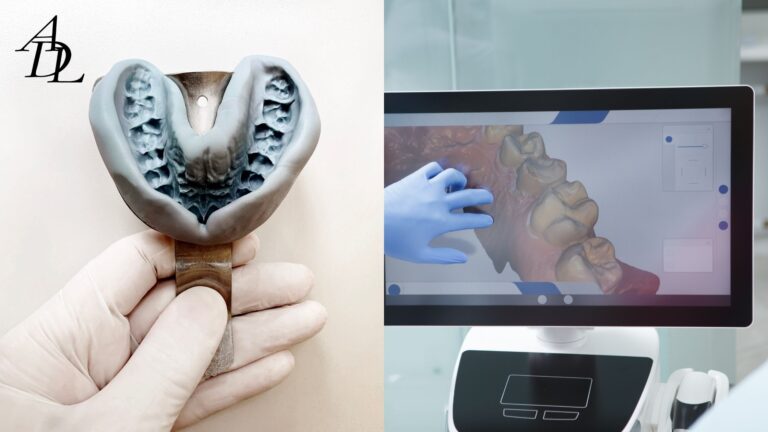
Good dental lab case communication also means knowing when digital is ideal and when conventional records still serve the case better. Associated Dental Lab’s scan-versus-PVS guidance says scans shine when margins are visible, moisture is controlled, and the case is straightforward, while PVS can still be the better choice when margins are deep subgingivally, soft tissue is difficult, or longer-span conditions demand a more stable analog capture. ADL presents digital and analog workflows as complementary rather than competitive.
That is a useful mindset for anyone building a file formats for lab process. The question is not “Are we digital?” The better question is “What record type gives the lab the clearest, least ambiguous information for this case?” When that question drives the handoff, the dental lab prescription gets better and the seat appointment gets more predictable.
The implant/crown bridge handoff that prevents redesigns
Crown and bridge cases need more than a shade callout
For single crowns and fixed bridge work, the minimum handoff is usually not enough. Associated Dental Lab’s Rx guidance emphasizes material selection with a fallback, clear occlusion targets, defined margin expectations, and file labeling. That advice is practical because crown and bridge cases often slow down on exactly those points. If the lab does not know how to proceed when space is tight, whether light centric contact is preferred, or whether the technician should call before designing around an unclear margin, the case pauses.
A better crown or bridge handoff sounds like this in plain English: “This is the material we want, this is the backup material if clearance is limited, this is the shade story, this is the bite target, and this is whether to copy the provisional.” That level of detail makes the dental lab prescription useful instead of merely complete.
The implant/crown bridge handoff needs exact metadata
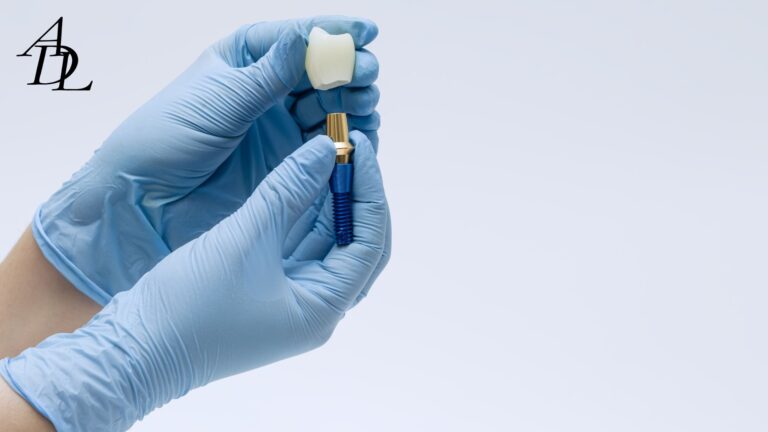
The implant/crown bridge handoff is where weak communication becomes most expensive. Associated Dental Lab specifically tells offices to over-communicate the implant system, platform, scan-body code or library, torque history, emergence profile, and whether a ti-base or hybrid solution is intended. ADL also highlights the need to say whether the restoration is screw-retained or cement-retained and to attach the proper upper, lower, bite, and photo records.
That level of detail matters because implants are less forgiving than routine fixed cases. The lab cannot safely infer platform size, screw channel preference, or emergence goals from a vague note that says only “implant crown.” In an implant/crown bridge handoff, precision is what prevents library mismatches, seating surprises, and redesign requests.
Removable cases benefit from the same discipline
Although this article focuses on lab case email handoffs, removable cases deserve equal attention. ADL’s Rx examples for removable work call for Kennedy classification, surveyed path of insertion, clasp location and type, undercut depth, finish line requests, and tissue or tooth shade information. If that design map is missing, the lab has to guess, and the office risks sore spots, redesigns, or remakes.
In other words, strong dental lab case communication is not just for complex esthetic crowns or implant work. It is equally important for partials, full dentures, and other removable appliances, especially when esthetics or comfort depend on subtle design choices.
Turnaround time scheduling: plan the case from the seat date backward
Published timelines only help if the handoff is complete
Turnaround time scheduling is where clinical planning and lab planning finally meet. The mistake many offices make is promising the patient a date before the handoff is fully assembled. A better workflow is to work backward from the seat date, confirm that the records are actually complete, and then match the case to the correct turnaround category. If the handoff is incomplete, the published timeline is no longer the real timeline.
Associated Dental Lab publishes the following turnaround windows:
- Same-day repairs and relines for local practices, when pre-scheduled and received before 10:30 AM
- Valplast and acrylic partial dentures: 4 business days
- Standard crown and bridge: 7 business days
- Cast frameworks: 7 business days
- Try-in and custom tray: 3 business days
- Provisional crowns: 3 business days
- Nightguards and retainers: 3 to 5 business days
- Full arch / hybrid and other larger cases: 10 to 15 business days
- Rush cases: must be pre-scheduled with the lab manager
Those are the published categories across ADL’s FAQ, products, and case submission pages.
Why turnaround time scheduling belongs inside the handoff email
Associated Dental Lab’s Rx guidance says to include both the due date and the patient appointment date. It also advises practices to tell the lab if an appointment moves, because the lab can re-slot production and finishing around the new schedule. That is an easy way to improve turnaround time scheduling without rushing every case.
The lesson is simple: do not separate production timing from dental lab case communication. Put the timing inside the same thread as the files and prescription. That way the lab sees not only what to make, but when it truly matters.
A lab email template dentistry teams can copy today
The phrase lab email template dentistry teams use every day may sound basic, but it is one of the easiest operational upgrades a practice can make. A reusable template reduces omissions, keeps the subject line consistent, and helps every team member remember what belongs in the handoff. It also supports the communication habits Associated Dental Lab recommends: one approver, one thread, bundled changes, and clear case identification.
The core template
Here is a practical lab email template dentistry teams can copy and adapt:
Subject: [Patient Last Name / Case ID] – [Tooth or Arch] – [Restoration Type] – Seat [Date]
Hello Associated Dental Lab team,
Attached are the dental lab prescription and records for the case below.
Case summary:
- Restoration: [example: #30 full-contour zirconia crown]
- Material fallback: [example: use higher-strength zirconia if clearance is limited]
- Shade: [base shade + stump shade if applicable]
- Esthetic notes: [texture, translucency, copy provisional, smile reference]
Records attached:
- Upper
- Lower
- Bite
- Photos
- Additional records if applicable
Occlusion and contacts:
- [example: light centric, no excursive contact]
Logistics:
- Patient appointment date:
- Requested delivery date:
- Standard or rush:
Approver:
- Name:
- Best mobile:
- Best email:
Please keep all replies in this same thread so the case history stays together.
Thank you.
That template is built directly from the information categories ADL asks offices to provide: case type, material, shade package, records, occlusion, due date, and approver.
Implant add-on block
For implant cases, add this block to the same email:
- Implant brand and platform
- Exact scan-body or library used
- Torque information
- Screw-retained or cement-retained
- Ti-base, custom abutment, or hybrid preference
- Emergence profile instructions
- Soft-tissue notes
- Access channel preference
- Provisional-copy request, if relevant
That is the heart of a complete implant/crown bridge handoff and matches the points ADL flags as essential for implant prescriptions.
The habits that make the template work
A template only works if the office uses it consistently. Associated Dental Lab’s case communication guidance adds four habits that are worth adopting immediately:
- Name one approver per case.
- Reply in-thread instead of starting a fresh email.
- Bundle changes instead of sending multiple small updates.
- Update the lab as soon as the patient appointment changes.
Those are small habits, but they have an outsized effect on dental lab case communication because they reduce orphaned notes and moving targets.
Practical examples that turn a vague handoff into a fast one
Example 1: Posterior crown
Weak handoff:
“Please make a zirconia crown on #30. Shade A2.”
Better handoff:
“#30 posterior zirconia crown. If clearance is limited, use the stronger option rather than requesting a redesign. Shade A2 with slightly lighter occlusal character. Upper, lower, and bite attached. Light centric contact. Seat date 4/18. Dr. Lee approves by text.”
The second version works because the dental lab prescription covers material, fallback, records, occlusion, timing, and approver.
Example 2: Anterior esthetic crown
Weak handoff:
“#8 e.max. Make it natural.”
Better handoff:
“#8 anterior lithium disilicate crown. Copy provisional length and facial line angles. Base shade A1, warm cervical, fine surface texture. Stump shade included. Two retracted shade photos attached with tab. Upper, lower, bite attached. Please call before design if margin visibility is limited.”
This version improves dental lab case communication because it tells the lab what “natural” means in clinical terms.
Example 3: Single implant crown
Weak handoff:
“Implant crown #19.”
Better handoff:
“#19 screw-retained zirconia implant crown on ti-base. Implant brand and platform listed below. Scan-body information attached. Copy the provisional emergence profile. Prefer lingual or palatal access. Upper, lower, bite, and soft-tissue photos attached. Torque history included. Delivery requested 4/22.”
This is a stronger implant/crown bridge handoff because it removes the questions that typically force the lab to pause.
Example 4: Maxillary partial denture
Weak handoff:
“Upper partial. Add clasps.”
Better handoff:
“Maxillary partial denture, Kennedy Class III. Surveyed path of insertion attached. Esthetic clasp request on selected teeth with identified undercuts. Tooth shade A2, light pink tissue. Finish line relief requested in the anterior. Bite record and tissue photos attached.”
The second version gives the lab a design map instead of a guess.
How Associated Dental Lab supports better handoffs
Associated Dental Lab is structured around the idea that communication quality affects restoration quality. On its site, ADL describes itself as a full-service dental laboratory crafting smiles since 1962, with direct communication with technicians, same-day local repair options in the Los Angeles area, digital and analog submission paths, CAD/CAM workflows, and predictable turnaround categories. The lab also highlights service lines across crown and bridge, implant solutions, removables, guards, and trays.
For digital practices, Associated Dental Lab accepts STL, PLY, and OBJ files, supports major scanner ecosystems, and provides a clear path for first-time case submission through account setup, online case sending, local pickup, mail, or courier. For offices that need real-time clarification, ADL’s FAQ says technicians are available during business hours, Monday through Friday, 8 AM to 4 PM PST. For esthetic work, ADL encourages photos and detailed notes. For peace of mind, it also publishes warranty coverage of up to one year on final fixed restorations and up to six months on removable appliances.
That combination matters. A lab can only help a practice move faster if the lab is built to receive good information quickly and act on it without confusion. Associated Dental Lab’s public guidance shows exactly that emphasis: simple case submission, clear communication, efficient workflows, and direct technician access.
Conclusion
A week is rarely lost all at once. It disappears in five-minute clarifications, missing attachments, conflicting shades, incomplete implant notes, and seat dates that were never shared with the lab. That is why strong dental lab case communication is such a powerful advantage. When the dental lab prescription is complete, the records are organized, the case photos for lab review are useful, the file formats for lab submission are correct, and turnaround time scheduling is stated upfront, the case moves with far less friction.
Associated Dental Lab has built its process around that reality. ADL is a Los Angeles-based full-service dental laboratory that has been crafting smiles since 1962, fabricates restorations in-house, supports both analog and digital workflows, and offers direct technician communication, same-day local repair options, and published turnaround windows. If you are looking for a dentists’ trusted Full-Service Dental Lab, contact us at Associated Dental Lab and see how a better handoff process can help your practice save time, reduce back-and-forth, and deliver more predictable results.
FAQ
What should a dental lab prescription include to avoid delays?
A dental lab prescription should include the case type, material and fallback plan, shade and stump shade, case photos for lab review, attached records, occlusion goals, due date, patient appointment date, and a named approver. Implant cases should add platform and scan-body information, while removable cases should add clasp and undercut design details.
How does a lab Rx checklist improve dental lab case communication?
A lab Rx checklist improves dental lab case communication by making every handoff follow the same standard. It reduces missing records, forgotten due dates, and contradictory notes, and it helps assistants, doctors, and front desk staff confirm that the case is truly ready before it leaves the office.
How many case photos for lab work should I send?
For esthetic cases, Associated Dental Lab recommends at least 2–3 retracted photos with the shade tab positioned properly, plus stump shade when needed. Depending on the case, soft-tissue photos, provisional references, and smile photos may also be useful. The goal is not volume for its own sake, but clear visual guidance.
Which file formats for lab submission does Associated Dental Lab accept?
Associated Dental Lab states that it accepts STL, PLY, and OBJ files from major intraoral scanners. It also supports scanner connections with systems such as DS Core, DEXIS, iTero, Medit / fastscan.io, and Trios, while still allowing other systems to export and upload appropriate files.
What belongs in an implant/crown bridge handoff?
A complete implant/crown bridge handoff should include the implant brand, platform, scan-body or library details, torque history, retention type, emergence profile notes, access channel preference, and the usual upper, lower, bite, and photo records. Without that information, the lab often has to stop and ask clarifying questions before design can begin.
Why is turnaround time scheduling so important?
Turnaround time scheduling matters because every case category has a different production window. Associated Dental Lab publishes different timelines for provisionals, standard crown and bridge, nightguards, full-arch hybrids, repairs, and rush cases. The more accurately the office shares the true seat date and urgency, the easier it is for the lab to plan production around the patient schedule.
What makes a lab email template dentistry teams actually use?
A lab email template dentistry teams actually use is short, repeatable, and complete. It includes a strong subject line, the dental lab prescription summary, attached records, esthetic notes, timing, and one approver. It also tells the lab to keep replies in the same thread so the case history stays organized.