Every indirect restoration begins with one simple question: is the record good enough to build from? If the answer is wrong, everything downstream gets harder—fit, contacts, occlusion, remake rate, patient trust, and schedule control. That is why a practice-wide poster for dental impression errors and intraoral scan errors is not a “nice extra.” It is quality control at the earliest, cheapest, and most fixable stage of treatment.
The need is real. In one classic evaluation of impressions sent to laboratories, 89.1% had at least one detectable error, with 50.7% showing voids or tears at the finish line and 40.4% showing air bubbles at the margin. In a later JADA study of 1,157 crown-and-bridge impressions, 86% had at least one detectable error, and 55% of the errors were critical finish-line problems. Blood and tray type were significantly associated with finish-line errors.
Digital records solve some analog problems, but they introduce their own failure modes. A 2025 review classified intraoral scan errors into operator-related and patient-related groups, including mesh-hole, stitching, tissue, reliability, implant scan body geometry, humidity, bridge, fuzzy finish line, and scanability-noise errors. In other words, a clean-looking scan can still be wrong in ways that are completely preventable if the team knows what to look for.
This article is built like a poster you can print and post. It gives you reject/accept criteria for both conventional and digital workflows, then explains the logic behind each call so your team can troubleshoot rather than guess. It also includes a quick impression troubleshooting pathway, full-arch scan accuracy cautions, and the exact details your lab needs to help you rescue borderline cases or reject them early.
Why a reject matrix matters more than “clinical intuition”
Many clinicians can sense when an impression or scan “doesn’t look great,” but intuition alone is inconsistent. A formal reject/accept criteria system standardizes what the practice will and will not send to the lab. That reduces subjective decision-making, improves assistant training, and prevents the common scenario where a borderline record is shipped “just to see if the lab can work with it.” As 3M’s precision impression compendium notes, standardization is one of the main routes to improved restorative fit because inconsistency in the early steps widens the error range before the case even reaches CAD or the bench.
Labs notice this difference immediately. Associated Dental Lab’s send-a-case workflow is built around complete submissions—lab slip, impressions or models, or direct digital scans from DS Core, DEXIS, iTero, Medit/fastscan.io, Trios, and other systems. Their digital QA blog also stresses that small scan stitching errors can snowball into open contacts, high occlusion, and full remakes if you do not catch them before pressing “send.”
How to use this poster in the operatory
Use the matrix in two stages:
- Immediate chairside triage: decide whether the record is clearly acceptable, clearly rejectable, or needs one rescue attempt.
- Final pre-send audit: if a rescue was attempted, re-evaluate the same criteria before the case leaves the office. This is especially important because some errors—like drags in conventional impressions or arch distortion in digital scans—are not reliably repairable and should trigger a new impression or rescan rather than a patch.
A simple rule helps: if the defect is in a critical area and you are not 100% sure what the lab should do with it, reject it and remake it. That is not overkill. It is cheaper than a remake, a failed seat, or an extra anesthesia appointment.
The poster summary: your one-glance reject matrix
Think of every record as falling into one of three bins:
- Accept: all critical detail is present, readable, and stable enough for fabrication.
- Rescue once: one identifiable problem can be corrected immediately without distorting the record.
- Reject: any critical defect in the finish line, intaglio geometry, interocclusal record, or global arch relationship that cannot be predictably corrected.
The rest of this article expands that into a true poster-style matrix.
Conventional impression reject matrix: dental impression errors that should stop the case
1) Voids, bubbles, or folds at the margin
What it is: a disruption in surface continuity at or near the finish line, often seen as round bubbles, pits, or folds in the wash.
Accept if:
- the defect is far from the preparation margin and not involved in occlusal stops or contact areas.
- the preparation finish line is otherwise completely clear and continuous.
Reject if:
- any bubble, void, or fold touches the finish line or critical anatomy.
- the margin is interrupted or unreadable.
- the defect sits where the restoration thickness or emergence profile will be determined. Madanshetty’s review explicitly states the impression should be redone if voids or folds are present in important areas.
Why it happens:
- saliva or blood contamination at the margin
- poor gingival retraction
- air incorporated during mixing or syringing
- exceeded working time
- incorrect syringing technique.
Quick fix:
- improve moisture control impressions with better retraction/hemostasis
- keep the syringe tip immersed in material during expression
- use automix where possible, since studies report fewer bubbles than hand spatulation in comparable workflows.
2) Drag, pull, or tear in the impression
What it is: a streaked or stretched distortion where material was dragged over a margin or an interproximal area, often from tray contact, movement, or premature removal.
Accept if:
- the drag is outside all critical restorative areas and does not affect the preparation, contacts, or occlusal anatomy.
Reject if:
- the drag/bubbles impression defect is near the margin, guide surface, or contact area.
- a tear crosses the finish line or creates uncertainty about where the margin truly is.
- the defect may reflect tray distortion. CE guidance notes that drags often are not correctable by relining and that a new impression is advised.
Why it happens:
- tray contacting the teeth during insertion
- impression movement during setting
- material too thin beyond the margin
- premature removal.
Quick fix:
- avoid tooth–tray contact during seating
- ensure adequate material thickness around the margin
- wait for the full setting time instead of removing “when it feels set.”
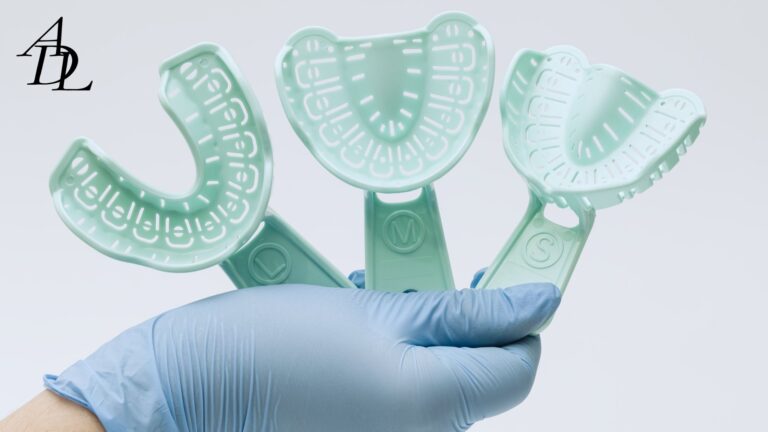
3) Tray show-through or material separation from the tray
What it is: visible tray through the material in a critical zone or impression material pulling away from the tray itself.
Accept if:
- show-through occurs only in noncritical peripheral areas that do not affect the case.
Reject if:
- tray shows through near the prep, opposing occlusal stops, or critical anatomy.
- the material separates from the tray anywhere that could alter the relationship of the impression. Madanshetty’s review lists tray show-through in crucial areas and separation from the tray as explicit redo triggers.
Why it happens:
- too little material
- poor tray adhesive use or timing
- seating pressure imbalance
- inadequate tray selection.
Quick fix:
- correct tray size and adhesive protocol
- confirm adequate wash space and proper material bulk.
4) Unmixed material streaks or polymerization defects
What it is: obvious streaks of unmixed base/catalyst or nonhomogeneous material texture.
Accept if:
- never. A material chemistry error is a reject.
Reject if:
- any obvious streaks or curing irregularities are present. Madanshetty’s evaluation criteria explicitly list obvious streaks of unmixed material as a reason to redo the impression.
Why it happens:
- incorrect mixing
- cartridge/mixing-tip problems
- expired material
- interrupted workflow.
Quick fix:
- replace tip/material, restart, and verify automix flow before reloading the tray.
5) Inadequate retraction or tissue over the margin
What it is: tissue obscuring the finish line, often combined with blood, fluid, or a “fuzzy” wash around the prep. In Rau’s JADA study, tissue over the finish line was the single largest error category at 49.09%. Blood significantly increased finish-line errors.
Accept if:
- the full finish line is still clearly visible and continuous despite minor soft-tissue presence away from the margin.
Reject if:
- any part of the finish line is hidden, ambiguous, or distorted by tissue or blood.
Why it happens:
- poor tissue displacement
- insufficient hemostasis
- rushed impression timing. Impression quality studies repeatedly identify soft-tissue management as one of the main causes of unacceptable records.
Quick fix:
- improve moisture control impressions with cord or paste, hemostatic control, and better timing.
Digital reject matrix: intraoral scan errors that should stop the case
1) Mesh holes or missing margin data
What it is: visible gaps in the scan mesh, especially at the prep margin or inside the prep. Revilla-León’s 2025 classification lists mesh-hole errors among core operator-related intraoral scan errors.
Accept if:
- the hole is in a noncritical soft-tissue zone that does not influence margin, contacts, or occlusion, and the surrounding geometry is stable.
Reject if:
- there is any mesh hole at the finish line, internal line angle, or critical restorative surface.
- the margin is incomplete or the scan must “guess” the edge. ADL’s pre-send QA article specifically flags incomplete margins as a common digital failure.
Why it happens:
- poor line-of-sight
- scanner lifted too far from the surface
- insufficient overlap
- difficult gingival proximity. Keeling’s work showed that margin quality worsens when margins are equigingival and when adjacent teeth and gingiva reduce scanner access.
Quick fix:
- dry the field, retract tissue, and rescan the local zone immediately.
2) Scan stitching errors and global arch distortion
What it is: misaligned frames that create step-offs, duplicated anatomy, warped arches, or “banana” distortion across a long span. ADL’s blog explains that scan stitching errors arise when overlapping images lack enough geometry or alignment is disrupted, and that they can snowball into open contacts and high occlusion.
Accept if:
- the deviation is minor, local, and outside all critical restorative or bite zones, and a local rescan restores clean geometry.
Reject if:
- there is visible double anatomy, broad step-offs, unilateral bite mismatch, or global arch twist.
- the full arch looks distorted or the bite relationship appears unilateral/nonreproducible. ADL’s QA guide lists double anatomy, step-offs, unilateral bite data, and global arch distortion among the major red flags.
Why it happens:
- inadequate overlap
- feature-poor spans
- operator path deviation
- long full-arch scans, where small misalignments accumulate over distance. Reviews and in vitro studies show that complete-arch scans are more error-prone than quadrant scans, and that scan stitching errors accumulate particularly over flat or edentulous spans.
Quick fix:
- rescan in a controlled segment with overlap
- consider scan aids for full-arch implant cases
- if the full arch remains unreliable, reject and restart rather than patching a distorted model.
3) Humidity, saliva, and scanability noise
What it is: moisture-related optical noise that obscures surfaces, especially shiny areas, deep margins, or edentulous tissue. The 2025 scanning-error classification specifically includes humidity and scanability noise among patient-related errors.
Accept if:
- the noise is superficial and a quick dry/rescan restores crisp data.
Reject if:
- persistent moisture makes the margin fuzzy, noisy, or incomplete after one rescue attempt.
Why it happens:
- saliva pooling
- fogging
- uncontrolled soft tissue and poor field isolation.
Quick fix:
- dry aggressively, isolate, and rescan; if the scanner still cannot see the margin clearly, switch techniques rather than forcing the digital route.
4) Fuzzy finish line or tissue-attached errors
What it is: margin blur from soft tissue overlap, inadequate retraction, or scanner access limitations. Revilla-León’s classification includes fuzzy finish line and tissue-related errors; Keeling’s margin-quality paper showed that equigingival and hard-to-see margins degrade scan quality.
Accept if:
- the finish line is continuously visible after local rescan and tissue displacement.
Reject if:
- any portion of the finish line remains unclear after proper retraction and moisture control.
Quick fix:
- retract, dry, improve line-of-sight, and rescan. If that still fails, conventional impressioning may be more predictable.
5) Bite registration mismatch or unilateral bite data
What it is: the arches articulate incorrectly because the buccal bite capture is incomplete, unilateral, or distorted. ADL’s pre-send QA specifically recommends bilateral bite validation and even a second buccal bite if anything appears off.
Accept if:
- bilateral occlusal landmarks align cleanly and the bite reproduces the patient’s known occlusion.
Reject if:
- the bite appears to hinge from one side, leaves one side open, or conflicts with baseline contacts.
Quick fix:
- repeat the bite capture, ideally after verifying the patient closes into a stable MIP.
Full-arch scan accuracy: why your reject threshold should be stricter
Full arches are their own category. Moon’s 2020 study found complete-arch scans had greater error than quadrant scans, especially in posterior segments, with complete arches around 0.09–0.10 mm and quadrant scans around 0.05–0.06 mm in that setup.
Other work confirms the same direction: full-arch scan accuracy is more vulnerable to cumulative drift, especially in feature-poor or edentulous areas, and flat spans worsen stitching problems.
That means your reject/accept criteria should be more conservative for full-arch digital cases:
- small local defects may be acceptable in quadrant scans if they can be corrected immediately
- the same “small” defect in a full arch may signal broader distortion and justify a complete rescan
Associated Dental Lab’s full-arch QA guidance recommends a smarter scanning strategy with intentional overlap and segment control precisely because full arches magnify drift.
The one-rescue rule: when to troubleshoot and when to stop
The best impression troubleshooting rule is simple: allow one focused rescue attempt for a defect you understand. Reject everything else.
Good rescue candidates
- one localized digital margin hole after you dry and retract
- one obvious interproximal drag that can be corrected by re-impressing with controlled relief and a light-body “patch” if the tray is not distorted
- one missing bite segment that can be re-scanned or retaken predictably
Poor rescue candidates
- broad digital arch distortion
- multiple scan stitching errors
- any drag/bubbles impression defect involving multiple critical zones
- tray separation or show-through in a critical area
- persistent fuzzy finish line under moisture or bleeding
- anything that makes you say “the lab might be able to figure it out”
Kurtzman’s protocol paper puts it plainly: proceeding with impressions that show significant defects reduces restorative accuracy and integrity.
Moisture control impressions: where conventional and digital failures overlap
One of the most useful lessons from comparing dental impression errors and intraoral scan errors is that many failures have the same root cause: fluids at the margin.
In conventional impressions, saliva and blood are linked to voids, bubbles, and finish-line defects. Madanshetty’s review points to saliva or blood around the prep as a cause of marginal voids, and Rau’s large JADA series found blood significantly increased finish-line error frequency.
In digital scanning, the same clinical reality shows up as humidity noise, fuzzy margins, and tissue-related scan errors. The technology changed, but the tissue and moisture did not.
This means one of the best “poster” rules you can teach your team is:
If the margin is wet, you do not have a record yet.
The lab handoff: what to send when the case passes
Once the record meets your reject/accept criteria, send it completely. ADL’s digital intake page shows that they accept direct scans from DS Core, DEXIS, iTero, Medit/fastscan.io, Trios, and other systems, and they ask for a completed lab slip with the case. Their send-a-case page also notes local pickup, prepaid shipping, in-house fabrication in Los Angeles, and scanner-specific connection steps.
For every acceptable case, include:
- complete lab slip
- material/restoration choice
- shade information and photos if esthetics matter
- bite record or digital bite confirmation
- notes on any rescue attempt you made so the lab is not surprised by what it sees
If the case is full arch or complex, add a note about any scan aids or segment strategy used. That helps the lab interpret the data more confidently.
Practical examples
Example 1: bubble at the distal margin of a crown prep
The impression looks otherwise good, but there is a round void touching the finish line distally. This is a reject. Madanshetty’s review and Kurtzman’s protocol both support remaking impressions when critical margin defects are present. Do not ship this because “it’s only one bubble.”
Example 2: digital scan with a crisp prep but unilateral bite
The scan looks beautiful, but the buccal bite only aligns on one side and leaves the opposite side visibly open. That is a reject until the bite is repeated. ADL’s QA guidance specifically warns about unilateral bite data as a major red flag.
Example 3: complete-arch scan with slight posterior twist
In a quadrant, you might have accepted a small local deviation. In a full arch, Moon’s data and other full-arch studies suggest that posterior drift is exactly where complete-arch digital records become less reliable. This is a reject/rescan, not a “hope the lab fixes it” situation.
Example 4: PVS impression with one drag in the canine area
If the tray is undistorted and the defect is truly localized and noncritical, a controlled rescue may be possible. If the drag crosses a margin or suggests tray distortion, reject it. CE guidance is clear that drags often are not safely corrected by simply adding more material.
Final poster text you can tape by the scanner or impression tray area
If you want the one-page rule set, make it this:
Reject immediately if:
- margin is missing, fuzzy, or covered by tissue
- bubble/void/fold touches a finish line
- drag/tear crosses a critical area
- tray shows through near the prep
- material separates from the tray
- digital scan shows double anatomy, major step-off, mesh hole at the margin, or unilateral bite
- full arch shows visible twist or cross-arch distortion
Rescue once if:
- one localized digital hole can be dried/retracted and rescanned
- one local bite segment can be repeated
- one isolated noncritical analog defect can be predictably corrected without distortion
Accept only if:
- all critical margins are visible and complete
- contacts, occlusion, and bite relationship are readable
- there is no obvious distortion
- you would be comfortable approving the restoration for your own mouth
Conclusion
A good impression or scan is not “whatever looks mostly okay.” It meets clear reject/accept criteria, especially at the finish line and in the bite. The strongest practices teach this the same way every time: identify the defect, decide whether it is critical, allow one focused rescue attempt if appropriate, and reject everything else before it leaves the office.
That is how you reduce dental impression errors, catch intraoral scan errors before they become remakes, and protect full-arch scan accuracy from the cumulative damage of scan stitching errors. More importantly, it is how you stop wasting chair time on records that were trying to tell you they were bad from the start.
Associated Dental Lab is a dentists trusted Full-Service Dental Lab in Los Angeles with direct digital scan intake, downloadable lab slips, local pickup, prepaid shipping, and in-house quality control—exactly the kind of lab setup that supports a disciplined reject matrix. If you want fewer remakes and cleaner lab handoffs, send your next case to Associated Dental Lab once it truly passes your poster checklist.
FAQ
1) What should trigger an automatic reject for dental impression errors?
Any bubble, void, fold, drag, or tear that affects the finish line or critical restorative anatomy should trigger a reject. Modern reviews and protocol papers specifically recommend redoing impressions when critical defects are present.
2) What are the most important intraoral scan errors to catch before sending?
The most important intraoral scan errors are mesh holes, scan stitching errors, fuzzy finish lines, humidity-related noise, incomplete margins, unilateral bite data, and global arch distortion. The 2025 error-classification review and ADL’s pre-send QA article align strongly on these themes.
3) Are scan stitching errors always worse in full arches?
They are usually more likely and more consequential in complete-arch workflows because small misalignments accumulate over distance. Studies show complete-arch scans generally have greater error than quadrant scans, particularly in posterior areas.
4) How do drag/bubbles impression defects usually happen?
Bubbles and voids often arise from air incorporation, saliva or blood at the margin, poor syringing, or exceeded working time. Drags and pulls often arise from tray/tooth interference, movement during setting, or premature removal.
5) Why is moisture control impressions training so important?
Because moisture is one of the few variables that can ruin both analog and digital records. In conventional impressions it contributes to bubbles and finish-line errors; in digital scans it creates humidity noise and fuzzy finish lines.
6) What are reasonable reject/accept criteria for a digital bite scan?
Accept only when the buccal bite reproduces the patient’s expected occlusion bilaterally without unilateral opening or mismatch. If the bite relationship looks wrong, repeat it before sending. ADL specifically recommends bilateral bite validation and a second buccal bite when needed.
7) What is the most useful first step in impression troubleshooting?
Identify whether the defect is in a critical area. If it affects the margin, occlusion, or full-arch relationship, reject it unless you can perform one focused, distortion-free rescue. If you cannot explain the defect, do not ship it. That rule is supported by both impression-quality studies and scan-error classification work.