A short clinical crown can make even a routine restorative case feel unpredictable. The prep may look clean, the margin may be readable, and the material choice may be sound, yet the case still feels risky because crown retention is no longer working in your favor. That is the moment when many clinicians are tempted to jump straight to a different plan: deeper margins, crown lengthening, forced eruption, a more aggressive buildup, or even abandoning the original restorative path altogether. The better first question is simpler: have you fully optimized the prep features that improve retention before changing the treatment plan?
That question fits closely with Associated Dental Lab’s broader clinical guidance. Across its articles on resin cement selection, margin elevation versus crown lengthening, scan versus PVS decision-making, and crown seating, ADL repeatedly frames success as a match between biology, biomechanics, and execution. In plain terms, that means crown retention is rarely about one magic product. It is usually about geometry first, isolation second, material-specific bonding third, and a plan change only when those basics still do not create a predictable case.
For a general reader, a short clinical crown is not just a tooth that looks short above the gumline. A classic prosthodontic definition describes it as a tooth with less than 2 mm of sound, opposing parallel walls remaining after occlusal and axial reduction. That matters because crown retention depends heavily on how much vertical wall, surface area, and frictional geometry remain once the tooth is prepared. When those features shrink, the crown has less to grip.
This article explains how to improve a short clinical crown before you change the plan. We will cover short prep retention, auxiliary grooves crown prep design, total occlusal convergence, crown prep taper, resin cement for short prep cases, and the moment when the prep has told you that surgery or a different restoration really is the better answer. We will also tie those clinical steps back to Associated Dental Lab’s lab-informed workflow, because better lab communication often prevents a borderline prep from turning into a remake.
Why a short clinical crown is harder to retain
The definition clinicians use
A short clinical crown is a biomechanical problem before it is a laboratory problem. The literature describes crown retention and resistance as being influenced mainly by crown length, total occlusal convergence, axial surface area, and the relationship between axial wall height and tooth width. Secondary features such as boxes, grooves, or pins can help, but they are not the first lever. The main message is that the shorter and wider the prepared tooth becomes, the easier it is for a crown to tip, rotate, or dislodge.
That last point is easy to miss in daily practice. A 3 mm wall height on a narrow premolar does not behave the same way as a 3 mm wall height on a broad molar. The short, wide tooth gives the crown a longer lever arm for displacement. That is why one lower molar with modest occlusal wear can feel much less secure than another tooth that measures similarly on paper.
Why placing the margin deeper is usually not the first fix
One common instinct in a short clinical crown case is to chase more retention by dropping the finish line subgingivally. That can buy visible “length” on paper, but it often trades one problem for several others. The short clinical crown review notes that deep subgingival margins can jeopardize periodontal health, complicate provisionalization, make impression-making harder, and interfere with accurate isolation during cementation. Associated Dental Lab’s margin strategy guide makes the same point with newer language: if the planned finish line violates the supracrestal tissue attachment and isolation becomes unrealistic, you are moving into a biologic problem, not solving a retention problem.
That is why good crown retention starts with the prep you already have, not with a reflexive decision to go deeper. If the margin is sulcular but isolation is achievable, deep margin elevation may be the conservative answer. If ferrule is impossible without violating the attachment, crown lengthening may be safer. But those decisions come after you have honestly assessed the existing prep geometry.
Geometry first: the prep changes that most improve crown retention
Preserve wall height before you remove more tooth
If there is one rule that consistently improves short prep retention, it is this: protect vertical wall height. A classic review in the Journal of Prosthetic Dentistry recommended a minimal occlusocervical dimension of 4 mm for molars and 3 mm for other teeth, along with an occlusocervical-to-faciolingual ratio of at least 0.4. Those are not magic numbers for every case, but they remain useful targets because they remind you that every extra fraction of a millimeter of vertical wall matters.
In practical terms, that means avoiding unnecessary occlusal reduction, eliminating undercuts with a thoughtful foundation rather than over-flaring the walls, and resisting the urge to “smooth” the prep into a shorter, more tapered stump. The review on short clinical crown management also warns that the prep should not rely on foundation material as the principal source of retention. Sound tooth structure still does the real work.
Associated Dental Lab makes a similar geometry-first point in its ti-base retention article. That article is about implant components, not natural teeth, but the biomechanical lesson is transferable: greater height and better wall engagement increase surface area and anti-rotation, while less taper improves frictional retention. In other words, whether the interface is tooth-to-crown or ti-base-to-ceramic, height still matters. That is a reasonable clinical inference from ADL’s workflow guidance and the prosthodontic literature on short preparations.
Why crown prep taper and total occlusal convergence matter so much
Crown prep taper is the everyday language many clinicians use for total occlusal convergence, or TOC. Technically, TOC is the angle created by the convergence of two opposing axial walls. The more those walls flare, the less frictional resistance the preparation offers.
The classic Goodacre review recommended 10° to 20° of total occlusal convergence for complete crowns. That range is clinically achievable, but it should not be misunderstood to mean that more taper inside that range is equally forgiving, especially in a short clinical crown. More taper may still seat easily, but it usually buys that convenience at the cost of crown retention.
The newer evidence is especially helpful here. In a 2024 in vitro study of 3 mm short-prepared molars, raising total occlusal convergence from 10° to 20° reduced retentive values, and the plain 20° group produced the lowest retention. That same study found that once the prep was already over-tapered, added features such as a proximal box or buccal groove could recover some of that lost retention. The lesson is simple: do not accept an over-tapered short prep as “good enough” if you can still correct the geometry.
An older in vitro study showed a similar trend from a different angle. Preparations in the 6° to 12° TOC range performed better than wider tapers, and increasing taper to the equivalent of 18° to 24° TOC significantly reduced retention. The authors also reported that the highest taper group showed roughly a 50% reduction in retention compared with the most parallel group, illustrating just how unforgiving an over-flared prep can become.
Reducing cervical TOC can outperform grooves
One of the most useful findings for short prep retention comes from a 2011 study on compromised short molars. The investigators compared proximal grooves with a different modification: reducing TOC in the cervical 1.5 mm of the preparation. Both changes improved resistance form, but reducing the cervical TOC was significantly more effective than adding proximal grooves alone. That matters because it tells you where the first rescue move often belongs: not in adding more features, but in making the lower portion of the prep less tapered when the tooth structure allows it.
For daily practice, that means crown prep taper should be checked from at least two views before you decide the case “needs grooves.” If the cervical half of the prep has already been over-opened, tightening that geometry may give you more return than immediately cutting extra retention features. A short clinical crown often rewards discipline more than creativity.
Preserve line angles and think in ratios, not just millimeters
The Goodacre review also recommends preserving facio-proximal and linguo-proximal line angles whenever possible. That guidance is not cosmetic. Sharply over-rounded line angles reduce resistance form by making rotational displacement easier. On a short clinical crown, that lost resistance becomes clinically meaningful very quickly.
This is where short prep retention becomes more about proportion than a single measurement. A 3 mm prep might be serviceable if the tooth is narrow, the walls are controlled, and the line angles are preserved. The same 3 mm on a wide molar with heavy crown prep taper may be one occlusal adjustment away from trouble. Crown retention is always about the whole prep, not just the ruler reading.
The best rescue features for short prep retention
Auxiliary grooves crown prep design
A short clinical crown does not allow a routine crown prep to behave like a routine crown prep. The classic review on short clinical crowns says exactly that: when height and convergence are compromised, additional design features are required to compensate for the lost retention and resistance form. Grooves, boxes, and other auxiliary devices are the traditional response.
The phrase auxiliary grooves crown prep is useful because it reminds you that the groove is not decoration. Its job is to add resistance to rotation, control the path of placement, and increase the effectiveness of the remaining walls. A groove does not replace good geometry, but it can improve a compromised prep when used deliberately.
The newer 2024 short-crown study is especially practical: with 20° TOC and 3 mm height, both a buccal groove and a proximal box improved retention, but the proximal box produced the highest retentive values. The study’s conclusion was straightforward: auxiliary features improved crown retention on short preparations with increased taper, and the box performed better than the groove in that setup.
Proximal boxes and cervical control are often stronger than adding more grooves
The Goodacre review recommends axial grooves or boxes, preferably on proximal surfaces, when the standard retentive features are missing. That is consistent with the newer evidence favoring proximal box modifications in short-prepared molars. A proximal box generally adds surface area, limits rotation, and does so in a location that directly supports the path of insertion.
The practical takeaway for better short prep retention is this:
- Correct the crown prep taper first if the cervical half of the prep has been over-opened.
- If the short clinical crown still lacks resistance, add auxiliary grooves crown prep features or a proximal box in solid tooth structure.
- Prefer a small number of well-aligned features over excessive cuts that make seating harder.
- Remember that more grooves are not always better; the literature notes that multiple grooves can complicate seating and precision.
What a core buildup can and cannot do
A core can be helpful in a short clinical crown case, but it should be used for the right reason. The short clinical crown review notes that foundation restorations can gain length and eliminate voids, undercuts, and irregularities. That can absolutely improve the shape of the prep. But the same review also warns that sound tooth structure should remain the principal source of retention. In other words, the buildup should support the prep design, not pretend to be the entire retention plan.
For endodontically treated teeth, that distinction matters even more. A post and core may be necessary to retain the core, but it does not erase the need for ferrule, reasonable crown prep taper, and usable wall height coronally. If those coronal features are still missing, the clinician may be dealing with a treatment-planning problem rather than just a buildup problem.
Cement strategy for a short clinical crown
When resin cement for short prep cases is the right move
Associated Dental Lab’s resin cement guide offers one of the clearest practical frameworks for this topic: first decide whether the case is mainly a retention case or a bonding case. If full coverage has ideal height and taper, the cement can function more as a luting step. If the case is a veneer, onlay, or short/tapered full crown, you are relying on adhesion, which changes the cement strategy. That is exactly why resin cement for short prep situations is often not optional but central to the plan.
ADL also separates self-adhesive and adhesive pathways in a clinically useful way. Self-adhesive resin cements reduce technique-sensitive steps and can work well when retention form is already adequate. Adhesive resin cement systems are more demanding, but they offer stronger bonding, especially to enamel, and are often the better choice when crown retention is compromised. For a short clinical crown, that distinction matters more than brand preferences do.
Material-specific bonding matters just as much as the cement category
For zirconia with compromised retention form, ADL recommends treating the case as a bonding case: air abrade the intaglio, clean it thoroughly, use an MDP-containing primer, and cement with an adhesive resin cement, often dual-cure for full crowns. That is an excellent example of resin cement for short prep cases being part of a full protocol, not a standalone fix.
For lithium disilicate, the pathway is different. ADL’s guide recommends hydrofluoric acid etching per the material’s instructions, followed by silane and adhesive resin cement, especially when long-term retention and esthetics are priorities. Again, the message is not “use resin.” The message is “use the right surface treatment and the right resin for the material in front of you.”
That material-first logic is supported by lab and bench evidence. An in vitro study on zirconia crowns found that adhesive cementation improved fatigue resistance compared with zinc phosphate cementation. That does not mean adhesive cement can compensate for any prep, but it does support the idea that when crown retention is already at risk, the cementation strategy can materially improve the restoration’s durability.
What resin cement for short prep cannot rescue
There is still an important limit here. Cement alone does not solve bad geometry, wet fields, or contaminated intaglios. ADL is explicit on this point: a “strong cement” does not overcome a contaminated substrate, and isolation determines whether a bonded protocol is predictable or risky. The dislodged-crown recementation literature makes a similar point from the mechanical side: the shape of the prep must place the cement under favorable loading, not ask it to resist everything by adhesion alone.
That is why resin cement for short prep cases should be thought of as a force multiplier, not a miracle. Use it when the prep is short or tapered and the material benefits from bonding, but only after confirming that the field can be isolated and the geometry has been improved as far as the tooth will safely allow.
Records, margin capture, and seating errors that can mimic poor crown retention
Scan when you can see, PVS when biology is in charge
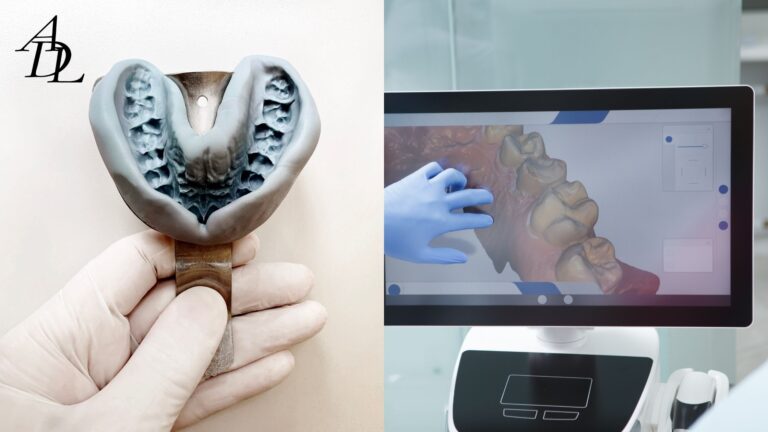
A short clinical crown can look like a retention problem when it is partly a record problem. Associated Dental Lab’s scan-versus-PVS guide says scanners perform best when margins are supragingival or equigingival, moisture is controlled, and the case is a short-span fixed restoration. PVS becomes the safer choice when margins are deep subgingival, bleeding persists, or the scanner simply cannot read the finish line consistently.
That matters because short prep retention is undermined when the lab builds to a margin the clinician could not truly capture. A borderline short clinical crown becomes even less forgiving when the record is fuzzy, stitched poorly, or partially hidden by soft tissue. ADL even recommends documenting retraction technique on the lab slip because it signals how confident the office is in the margin capture.
Do not blame the prep until the crown is fully seated
Seat-day errors also confuse the picture. Associated Dental Lab’s crown seating checklist emphasizes that the restoration must be fully seated before occlusion is marked. Tight contacts can hold a crown off-seat, distort the occlusal marks, and make a secure preparation look unstable or “short” when the real issue is incomplete seating. The same checklist recommends dry try-in, explorer-based margin verification, floss calibration of contacts, and proper decontamination of zirconia after saliva exposure.
This is more important than it sounds. A short clinical crown already has less mechanical forgiveness. If the restoration is not completely seated, the clinician may start adjusting occlusion, second-guessing the prep, or over-treating the case when the smarter move is simply to fix the contact, confirm depth, and reassess. In borderline retention cases, seat-day discipline protects both the tooth and the treatment plan.
A practical workflow before you change the plan
Use this sequence for better short prep retention
Before converting a short clinical crown into a surgical or more aggressive restorative case, walk through this sequence:
- Confirm that the tooth is truly a short clinical crown, not just visually short, by assessing remaining sound wall height, width, ferrule potential, and overall restorability.
- Re-check crown prep taper and total occlusal convergence from multiple views; correct cervical over-taper if tooth structure allows.
- Preserve or rebuild usable height with a rational foundation, but do not rely on the buildup as the sole source of crown retention.
- Add auxiliary grooves crown prep features or a proximal box if geometry remains compromised after the basic correction.
- Decide whether the case is now a retention case or a bonding case, and choose resin cement for short prep situations only if you can execute the bonding protocol cleanly.
- Capture the margin with the right record: scan when the line is visible and dry, PVS when the field is biologically hostile.
- Only after those steps should you decide whether deep margin elevation, crown lengthening, forced eruption, or a different restoration is necessary.
That is the heart of the “before you change the plan” mindset. It respects the tooth, improves crown retention, and reserves surgery or major redesign for cases that truly need it.
Practical examples
Example 1: Worn mandibular molar with a short clinical crown
A lower molar presents with about 3 mm of wall height after reduction, and the existing prep has more crown prep taper than intended. Before moving to crown lengthening, the better sequence is to first reduce cervical TOC where possible, preserve the remaining line angles, and consider a proximal box if resistance still feels weak. If the final restoration is zirconia and the short prep retention remains questionable, ADL’s bonding framework supports treating the case as a bonding case with air abrasion, MDP chemistry, and adhesive resin cement rather than defaulting to a simple self-adhesive workflow.
Example 2: Endodontically treated molar with a deep proximal margin
In this situation, the short clinical crown problem is not only height. It is also biology and isolation. Associated Dental Lab’s margin strategy guidance would push the decision toward deep margin elevation if the margin is sulcular and can be isolated, or toward crown lengthening if the attachment would be violated and ferrule cannot be obtained conservatively. The key point is that dropping the margin deeper without solving isolation or ferrule does not improve crown retention in any durable way.
Example 3: Debonded zirconia crown on a compromised short prep
Here the temptation is to assume the cement “failed.” ADL’s resin cement guide suggests a more disciplined analysis: was the original prep a bonding case, was zirconia properly air abraded and primed with MDP, and was the intaglio contaminated at try-in? If the geometry is compromised and the surface treatment was weak, recementing without correcting those variables is just repeating the same error. Crown retention improves when the clinician treats the case as a geometry-and-bonding problem together.
When prep features are not enough and you really should change the plan
Deep margin elevation versus crown lengthening
Sometimes the short clinical crown has already told you the answer. Associated Dental Lab’s decision guide is very clear: choose deep margin elevation when the margin is sulcular but not within the supracrestal tissue attachment, isolation is achievable, and an adhesive restoration is appropriate. Choose crown lengthening when the attachment would be violated, isolation is unreliable, or you need 1.5 to 2.0 mm of ferrule for a full-coverage restoration on a structurally compromised tooth.
That is the real boundary line. If the case remains wet, biologically unsafe, or ferrule-poor after you have optimized height, crown prep taper, total occlusal convergence, and auxiliary features, then the prep changes have done their job by revealing the truth. At that point, changing the plan is not over-treatment. It is good treatment planning.
The signs that should stop you from “pushing through”
A short clinical crown is usually telling you to change the plan when you see one or more of these:
- Ferrule cannot be created without violating the attachment.
- Isolation is too unreliable for a bonded protocol.
- The remaining tooth is too wide for its available height, even after correcting taper.
- The buildup is doing more work than the remaining tooth structure.
- Margin capture is still unreadable despite appropriate retraction and record selection.
Those are not failures of technique. They are the signs of a case that has moved from a crown retention problem into a biologic or restorability problem.
Why lab collaboration matters in short clinical crown cases
The lab can help before the remake, not just after it
Associated Dental Lab’s communication guidance is especially valuable in borderline cases. The lab asks clinicians to decide material and constraints first, state a fallback plan, attach prep, opposing, and bite records, and ask the lab for a quick recommendation if they are unsure before finalizing the case. That is exactly the kind of communication that helps a short clinical crown case succeed before it becomes a lost seat appointment.
This is not just administrative neatness. Material choice, margin design, and cement strategy interact more strongly in a short clinical crown than in an ideal prep. Sending the lab readable records, stating whether the case is intended as a bonded zirconia crown or a more conventionally retained restoration, and asking for input when space or retention is borderline can prevent the “one more compromise” cascade that ends in a debond or a remake.
What Associated Dental Lab adds to the process
Associated Dental Lab presents itself as a Los Angeles full-service dental laboratory that has been crafting smiles since 1962. On its site, ADL highlights direct communication with technicians, doctor-centered collaboration, same-day local repairs, streamlined turnaround, and support across crown and bridge, implants, removables, and guards. For clinicians managing a short clinical crown, that matters because the lab is not just fabricating the crown. It is helping evaluate margin readability, material selection, timing, and case execution before the crown is ever seated.
ADL’s zirconia crown page also notes that its zirconia restorations are compatible with conventional or adhesive cementation and invites clinicians to talk to a lab technician before sending the case. That is exactly the kind of support a short clinical crown case deserves: not a generic “send it over,” but a material and workflow conversation before the weak prep becomes a weak result.
Conclusion
A short clinical crown should slow your thinking, not rush you into changing the plan. Most of the time, crown retention improves when the clinician first tightens the crown prep taper, protects wall height, preserves line angles, adds auxiliary features only where they are needed, and uses resin cement for short prep cases only when the field and material truly support bonding. Geometry still leads. Adhesion helps. Biology sets the limit.
And when those improvements are still not enough, the answer is not to force the crown. It is to pivot intelligently to deep margin elevation, crown lengthening, or another restorative design that respects ferrule, isolation, and tissue health. That is the real lesson behind predictable crown retention: treat the prep honestly before you treat it aggressively.
Associated Dental Lab is a Los Angeles-based, dentists’ trusted Full-Service Dental Lab that has been crafting smiles since 1962. With direct technician communication, same-day local repair options, dependable crown-and-bridge turnaround, and support across fixed, implant, and removable cases, ADL is built to help clinicians manage difficult restorative decisions before they become remakes. Contact us at Associated Dental Lab to learn how we can support your next case and show you why so many practices rely on us as their trusted Full-Service Dental Lab.
FAQ
What is a short clinical crown, and why does it reduce crown retention?
A short clinical crown is commonly defined as a tooth with less than 2 mm of sound, opposing parallel walls remaining after occlusal and axial reduction. It reduces crown retention because wall height, axial surface area, and total occlusal convergence all become less favorable, making the crown easier to tip or dislodge.
How do crown prep taper and total occlusal convergence affect short prep retention?
Crown prep taper is the practical version of total occlusal convergence. As total occlusal convergence increases, short prep retention tends to drop because the walls become less parallel and less resistant to displacement. Both classic reviews and newer in vitro studies show that over-tapered short preparations lose retention, and that reducing cervical TOC can improve resistance even more than adding grooves alone.
Do auxiliary grooves crown prep features really improve crown retention?
Yes, auxiliary grooves crown prep features can improve crown retention when the short clinical crown has reduced height or excessive taper. The evidence suggests that grooves and boxes improve retentive values in short preparations, with proximal boxes often performing better than single buccal grooves in modern in vitro testing. They work best as targeted rescue features, not as substitutes for good prep geometry.
When should I use resin cement for short prep cases?
Resin cement for short prep cases is most helpful when the restoration is functioning as a bonding case rather than a simple luting case. Associated Dental Lab specifically places short or tapered full crowns into that bonding category, especially for zirconia crowns with compromised retention form or thin lithium disilicate restorations with good isolation. The key is that bonding only helps when the surface treatment and moisture control are correct.
What is the best way to improve short prep retention before I choose crown lengthening?
Start with the prep itself: preserve height, reduce crown prep taper, manage total occlusal convergence, and add auxiliary grooves crown prep features or a proximal box only if geometry alone is still insufficient. Then decide whether the case needs adhesive support with resin cement for short prep conditions. Only after those steps should crown lengthening enter the discussion.
Should I scan or take PVS for a short clinical crown with deep margins?
For a short clinical crown, scan when the margins are visible, supragingival or equigingival, and the field is dry. Choose PVS when the margin is deep subgingival, bleeding persists, or moisture control is unreliable. In short clinical crown cases, accurate margin capture is part of crown retention because unreadable margins create crowns that never had a fair chance to seat or bond properly.
Can a core buildup alone solve crown retention on a short clinical crown?
Not by itself. A core can improve prep form, eliminate undercuts, and sometimes gain usable height, but the literature on short clinical crown management warns that sound tooth structure should remain the principal source of crown retention. If the buildup is doing all the work and ferrule or geometry is still missing, the case may need a different plan.