Not every broken restoration needs a full remake. In many cases, smart triage and the right protocol can get patients comfortable quickly and preserve what’s already working. Other times, a “quick fix” risks repeated failures and wasted chair time. This guide distills what clinicians and patients should realistically expect from common repairs—from flexible partial denture repair (Valplast repair) to chipped zirconia crown repair—and outlines when a same-day solution is prudent, when a lab visit is wiser, and when a remake is the least costly path in the long run.
You’ll find clinically grounded guidance for:
- Acrylic denture repair and deciding denture tooth repair vs reline/rebase
- Flexible partial repair kit use vs lab reprocessing for nylon-based appliances
- Chipped zirconia crown repair with a proven zirconia crown repair protocol (MDP/silane/composite)
- Repair fractured porcelain crown (feldspathic/lithium disilicate) with intraoral ceramic repair resin
- PEEK framework repair realities and workarounds
As a full-service partner, Associated Dental Lab integrates digital and analog workflows and—importantly for repairs—offers same-day repairs and relines for local practices when cases arrive early enough, helping you keep treatment on schedule and patients smiling again.
What “Repairable” Really Means: Setting Expectations Up Front
Chairside vs. Lab vs. Remake
Think of repairability on a spectrum:
- Chairside repair – Quick stabilization using bonding systems and composites or cold-cure acrylic. Best for small chips, lost denture teeth, or interim fixes.
- Lab repair – Controlled environment for material-specific treatments (e.g., heat/pressure acrylic polymerization, nylon welding for flexible partials, precision rebases).
- Remake – Required when fractures reflect fundamental design or material limits (e.g., repeated midline acrylic breaks, severely delaminated porcelain, distorted frameworks).
A fast triage checklist
- Cause: trauma vs fatigue vs fit/tissue change
- Extent: chip, crack, through-and-through fracture, missing component
- Material: acrylic/PMMA, nylon (flexible partial), porcelain/zirconia, PEEK, metal/resin hybrid
- Service time left: provisional vs definitive, implant healing vs mature tissue
- Patient expectations: esthetics, schedule, willingness to return for refinement
The more you can align material behavior with patient expectations, the fewer callbacks you’ll see.
Acrylic & PMMA: Where Repairs Shine
Acrylic denture repair (complete and partial)
Conventional acrylic remains the most repair-friendly removable material:
- Common scenarios: fractured bases, midline cracks, debonded or lost denture teeth
- Chairside: cold-cure resin can stabilize minor fractures or reattach a tooth in a pinch
- Lab advantages: precise alignment on a model, pressure pot/heat curing for strength, shade-matched tooth replacement, and clean polish that resists plaque
When to reline vs rebase vs remake
- Reline when the base fits poorly but the denture is otherwise intact (tissue changes, post-extraction remodeling).
- Rebase when the base is crazed, porous, or repeatedly fractures—but teeth and occlusion are good.
- Remake when vertical dimension, occlusion, or tooth position are fundamentally off.
Patient script: “Acrylic can be repaired predictably, but repeated breaks hint the fit or occlusion needs correction. Fixing the base alone won’t solve a bite problem.”
Flexible Partials (Valplast and Similar Nylon-Based Appliances)
Flexible partial denture repair (Valplast repair)
Nylon-based partials (e.g., Valplast-type) are tough but tricky to repair. Their flexibility and low surface energy make traditional acrylic patching unreliable. Proper repair often requires heat and pressure with the original or compatible nylon, specialized surface prep, and in some cases welding procedures that are best done in a lab. Manufacturer technique resources emphasize correct conditioning and controlled processes for adjustments and repairs. Valplast® Flexible Partials
What’s realistic
- Small tears or fractured clasps: often lab-amenable with nylon reprocessing/welding.
- Added tooth or clasp: usually possible in the lab if there’s adequate base thickness and design room.
- Complete base splits: prognosis drops; consider remake or a rigid framework solution if failures recur.
Flexible partial repair kit—use cases
Chairside kits can help with minor edge smoothing or provisional stabilization, but durable Valplast repair typically needs lab processing to fuse fresh nylon to the existing base. Patients should expect a short lab visit rather than an in-chair permanent fix.
Pro tip: If a flexible partial has fractured more than once, reassess clasp path, tissue undercuts, and occlusal interferences. Sometimes the “repair” is a design change, not another patch.
Fixed Ceramics: Porcelain, Glass-Ceramics, and Zirconia
Repair fractured porcelain crown (feldspathic or lithium disilicate)
Silica-based ceramics (veneering porcelain, feldspathic, lithium disilicate) bond well to resin when the surface is properly etched and silanated:
Chairside protocol (typical)
- Isolate & roughen: microetch 30–50 μm Al₂O₃; protect soft tissues
- Etch: HF gel (time per IFU: ~60–120 s feldspathic; ~20 s lithium disilicate)
- Rinse & dry thoroughly; avoid salivary contamination
- Silane: apply, dwell per IFU
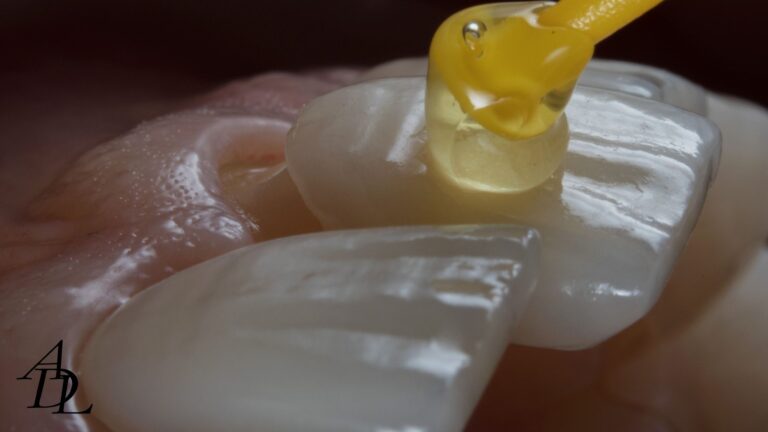
- Bond: use an intraoral ceramic repair resin/universal adhesive
- Composite build-up: layer and contour; finish & polish
This pathway can yield durable repairs for porcelain veneer chips, incisal fractures, and margin chipping when the ceramic core is sound.
Chipped zirconia crown repair—what’s different?
Zirconia isn’t silica-based, so traditional HF etch + silane is ineffective on untouched zirconia. Evidence supports micro-abrasion (sandblasting) plus an MDP-containing adhesive/primer to promote chemical bonding to zirconia’s oxide surface. Silane helps only if a silica-coated surface is created (e.g., tribochemical silica coating); otherwise, rely on MDP chemistry and mechanical roughening. PMC
Zirconia crown repair protocol (MDP/silane/composite)
- If exposed surface is monolithic zirconia
- Isolate and micro-abrade (e.g., 50–110 μm Al₂O₃)
- Rinse, dry; avoid saliva contamination
- Apply MDP-containing universal adhesive/zirconia primer (per IFU)
- Light-cure if indicated
- Layer composite to rebuild anatomy; finish/polish
Silane is not beneficial on raw zirconia unless you silica-coat first.
- If the chip exposes veneering porcelain on a zirconia framework
- Treat porcelain area as silica-based: HF + silane
- Treat any zirconia-exposed area with MDP primer
- Blend with composite using micro-hybrid/nano-hybrid for strength and polish
Recent studies and reviews reinforce MDP-based systems (with air-abrasion) as the most reliable chipped zirconia crown repair route intraorally. SAGE Journals
Patient script: “Repairs on zirconia can be very successful for chips. If large pieces are missing or occlusion is heavy, a lab veneer or remake might be smarter.”
Provisional & Hybrid Situations
PMMA vs bis-acryl provisional—repair notes
- PMMA: easy to repair/polish; strong with proper thickness
- Bis-acryl: bonds readily to itself but can be brittle; great for fast chairside fixes
For large provisional fractures (especially long spans), a lab-processed PMMA reinforcement or remake is typically more durable.
PEEK Framework Repair: Manage Expectations
Poly(ether-ether-ketone), or PEEK, is attractive for frameworks due to its strength and weight—but bonding to PEEK is challenging because of its low surface energy and chemically inert surface. Bond strengths improve with aggressive surface treatments (e.g., airborne particle abrasion, sulfuric-acid etch or plasma in lab settings) and specialized primers/adhesives designed for PEEK, followed by composite veneering. Even so, repairs are more technique-sensitive and less predictable than on acrylic or metal. BioMed Central
Clinical guidance
- Small veneering chips: consider mechanical retention (bevels/undercuts), appropriate primer, and composite layering; inform patients about guarded longevity.
- Framework cracks: often indicate design/connector issues—remake or redesign is usually indicated.
Implant Prosthetics: Repair vs Redesign
For screw-retained hybrids, fractured acrylic/PMMA teeth or gingiva can be repaired chairside or in-lab; repeated fractures suggest occlusal scheme or connector thickness changes. For zirconia hybrids, small chips may accept intraoral ceramic repair resin; extensive chipping or delamination is better addressed with a lab veneer or remake. Always check occlusal contacts, parafunction, and opposing materials to prevent recurrence.
When a “Repair” Becomes a “Service Plan”
Use these decision points to keep care efficient:
- One-time chip or crack with clear cause → repair and monitor
- Recurring fracture in same area → change design/material or remake
- Poor fit causing sore spots → reline/rebase rather than repeated tooth reattachments
- Aging flexible partial with repeated tears → consider a rigid framework or a new flexible design with stress distribution changes
Communication That Prevents Second Repairs
What your lab needs to succeed
- Clear photos (dry field), fracture close-ups, shade tabs
- Material ID (acrylic, Valplast-type nylon, zirconia brand if known, PEEK)
- Occlusion notes (excursive interferences, parafunction)
- Timeline (same-day possibility vs standard)
- Your plan (temporary triage vs definitive lab repair vs remake)
Associated Dental Lab supports digital submissions and same-day repairs/relines for nearby practices—a practical advantage when a patient’s schedule or comfort can’t wait.
Practical Mini-Scenarios
1) Small pit chip on a monolithic zirconia molar
- Plan: micro-abrade → MDP universal adhesive → micro-hybrid composite → polish
- Expectation: good short- to medium-term durability, especially after occlusal refinement
- If it recurs: evaluate contact strength and opposing material
2) Lost denture tooth (acrylic complete)
- Chairside: quick tooth reset with cold-cure for same-day comfort
- Lab: pressure-pot cure and repolish for longevity; check if a reline would prevent repeat debonds
3) Fractured flexible clasp (Valplast-type)
- Chairside: smooth sharp edges; temporary stabilization only
- Lab: flexible partial denture repair (Valplast repair) with nylon reprocessing/welding
- Counseling: if the same clasp has failed twice, consider altered design or alternative framework. Manufacturer techniques stress proper conditioning for durable outcomes.
4) Porcelain chip on layered zirconia anterior crown
- Plan: treat porcelain with HF + silane; treat any exposed zirconia with MDP; rebuild with composite
- Expectation: good esthetics; inform patient about color stability vs a lab veneer
5) PEEK framework veneer chip
- Plan: mechanical macro-retention + PEEK primer system + composite; warn about guarded prognosis
- \Alternative: lab veneer replacement or redesign if chips recur MDPI
Patient-Facing Messages That Build Trust
- “Repairs can be strong, but they’re not magic.” Some materials bond beautifully (acrylic, porcelain), others (nylon, PEEK) are repairable but technique-sensitive.
- “Quick fixes buy comfort time.” We can stabilize today; the lab makes it last.
- “Repeat breaks are a clue.” We may need to change the design, bite, or material—not just re-glue.
- “Prevention matters.” Night guards, hygiene, and regular checks protect your investment.
Frequently Asked Questions (FAQ)
1) Can a chipped zirconia crown repair last long term?
Yes—especially for small chips—when you follow a zirconia crown repair protocol (MDP/silane/composite): air-abrade, apply an MDP-containing primer/adhesive, and layer composite. Silane alone doesn’t bond well to raw zirconia; it helps only on silica-coated or porcelain surfaces. ScienceDirect
2) What’s the difference between repair fractured porcelain crown and zirconia repair?
Porcelain (silica-based) responds to HF etch + silane before composite. Zirconia needs air-abrasion + MDP chemistry (or a silica-coating step) for reliable bonding.
3) Is flexible partial denture repair (Valplast repair) possible chairside?
Minor edge smoothing is fine, but durable repairs typically require lab processing with compatible nylon. A flexible partial repair kit can temporize, yet lasting results come from lab reprocessing/welding. Manufacturer technique guidance supports lab-based conditioning for stability.
4) For a broken acrylic denture, when do I choose denture tooth repair vs reline/rebase?
If a single tooth pops off and the base fits, a tooth repair is fine. If cracks recur or the base rocks, choose reline (fit issue) or rebase (base integrity issue) to prevent future failures.
5) Can PEEK framework repair be done intraorally?
Small veneer chips can be patched with mechanical retention plus specialized PEEK primers and composite, but bond predictability is lower than acrylic or porcelain. Repeated chipping suggests lab veneer replacement or redesign.
6) Which resin works best as an intraoral ceramic repair resin?
Use a system compatible with your adhesive strategy: HF + silane + adhesive for porcelain, and air-abrade + MDP for zirconia. Many universal adhesives contain MDP; follow the IFU and isolate meticulously.
7) Can my lab really turn around repairs fast?
Yes—some labs (including Associated Dental Lab) offer same-day repairs and relines for local practices when cases arrive before a morning cutoff, helping you manage emergencies without disrupting the schedule.
Conclusion
Material dictates repairability. Acrylic denture repair is reliably strong when processed under pressure. Flexible partials can be repaired—but durable Valplast repair usually needs lab procedures with compatible nylon. Chipped zirconia crown repair is highly feasible when you respect the surface chemistry—air-abrade + MDP, with silane only for silica-containing areas. Porcelain responds beautifully to HF + silane and a quality intraoral ceramic repair resin. PEEK framework repair is possible but technique-sensitive; repeated failures often warrant redesign.
When you combine realistic expectations, material-specific protocols, and a responsive lab, you’ll save chair time, reduce remakes, and keep patients confident.
About Associated Dental Lab
Associated Dental Lab is a Dentists’ trusted Full-Service Dental Lab in Los Angeles—“Crafting smiles since 1962.” We accept digital files, integrate with your preferred workflow, and provide same-day repairs/relines for nearby practices when scheduled appropriately. Send your next repair case and let our team help you choose the most predictable path—stabilize today, and deliver lasting comfort tomorrow.